 D
DFigure 2-1: SRCR Cumulative Mean- All Carriers
The DOT Strategic Plan 2003-2008 states the Department of Transportation's safety strategic objective as "Enhance public health and safety by working towards the elimination of transportation-related deaths and injuries." As such, the Secretary has established a goal to reduce the highway fatality rate to not more than 1.0 per 100 million vehicle miles traveled by 2008. This is a 41% reduction from a 1996 baseline of 1.7 per 100 million vehicle miles traveled. Consistent with the Departmental goal, the Federal Motor Carrier Safety Administration (FMCSA) has set its goal of reducing the large truck-related fatality rate by 41% from 1996 to 2008. In support of this effort, FMCSA has established specific objectives focusing on individual areas of improvement as outlined in the 2010 Strategy: Saving Lives through Safety, Innovation and Performance document. These objectives, if met, will collectively lead toward FMCSA reaching its goal of 41% reduction in the truck-related fatal crash rate and support the Department's overall goal of a 41% reduction in the highway fatality rate.
Measuring the FMCSA's Safety Objectives from Year 2000 to 2002 was released in July 2003. This report updates that analysis and documents the progress of FMCSA toward meeting the specific safety objectives contained in the 2010 Strategy: Saving Lives through Safety, Innovation and Performance document. Work on the selection of metrics for tracking FMCSA progress towards the safety objectives was initiated by a series of studies that tested the utility of various SafeStat-related measures and other industry metrics. The metrics selected as the most appropriate depiction of the achievement of the safety objectives were then calculated based on semiannual SafeStat runs between March 2000 and September 2004. A trend analysis was conducted to document progress over time. This report will be updated periodically with more recent results from succeeding SafeStat runs.
The research for this report was conducted by the Research and Innovative Technology Administration's (RITA) John A. Volpe National Transportation Systems Center (the Volpe Center) in Cambridge, MA under a project plan agreement with the FMCSA. The two sponsoring divisions at the FMCSA are the Analysis Division (MC-RIA), managed by Dale Sienicki and the Strategic Planning and Program Evaluation Division (MC-PRS), managed by Scott Poyer. The Volpe Center project manager is Donald Wright, Chief of the Motor Carrier Safety Assessment Division in the Office of System and Economic Assessment. The analysis was performed at the Volpe Center by Julie Nixon, Courtney Stevenson, and Samer Balbaky of the Volpe Center, and under contract to the Volpe Center, Walter Zak, Arturo Torres, and Leon Parkin of Chenega Advanced Solutions & Engineering, LLC.
| AIM | Accident Involvement Measure |
|---|---|
| CDL | Commercial Driver License |
| CMV | Commercial Motor Vehicle |
| CR | Compliance Review |
| DIM | Driver Inspections Measure |
| DOOS | Driver Out-of-Service |
| DOT | Department of Transportation |
| DRM | Driver Review Measure |
| FARS | Fatality Analysis Reporting System |
| FMCSA | Federal Motor Carrier Safety Administration |
| FMCSR | Federal Motor Carrier Safety Regulations |
| HMR | Hazardous Materials Regulations |
| HOS | Hours-of-Service |
| ISS | Inspection Selection System |
| MCMIS | Motor Carrier Management Information System |
| MVM | Moving Violations Measure |
| NHTSA | National Highway Traffic Safety Administration |
| OOS | Out-of-Service |
| PCI-DOOS | Post Crash Inspection Driver Out-of-Service |
| PCI-VOOS | Post Crash Inspection Vehicle Out-of-Service |
| RAR | Recordable Accident Rate |
| RITA | Research and Innovative Technology Administration |
| SafeStat | Motor Carrier Safety Status Measurement System |
| SEA | Safety Evaluation Area |
| SMRM | Safety Management Review Measure |
| SRCR | State Reported Crash Rate |
| TCTWC | Total Consequence/Time Weighted Crashes |
| TVMTTWN | Truck Vehicle Miles TraveledTime Weighted Number |
| VIM | Vehicle Inspection Measure |
| VMT | Vehicle Miles Traveled |
| VOOS | Vehicle Out-of-Service |
The Federal Motor Carrier Safety Administration (FMCSA) document, 2010 Strategy: Saving Lives Through Safety, Innovation and Performance, establishes the agency mission of saving lives and reducing injuries in truck and bus crashes. In 2002 with the introduction of the DOT Strategic Plan 2003-2008, FMCSA aligned its goal with the Department of Transportation's overall rate-based safety goal. The DOT Strategic Plan 2003-2008 states the Department's strategic safety objective is to "Enhance public health and safety by working towards the elimination of transportation-related deaths and injuries." As such, the Secretary has established a goal to reduce the highway fatality rate to not more than 1.0 per 100 million vehicle miles traveled by 2008. This amounts to a 41% reduction from a 1996 baseline of 1.7 per 100 million vehicle miles traveled. Consistent with the Departmental goal, the FMCSA has set its goal of reducing the large truck-related fatality rate by 41% from 1996 to 2008. This reduction translates to a 2008 rate of 1.65 fatalities per 100 million truck vehicle miles traveled. Assuming a yearly increase of 3.4% in truck miles traveled, that rate would result in an estimated total of 4,330 truck-related crash deaths in 2008. This total compares to an estimated 7,376 deaths in truck-related crashes in 2008, if the fatality rate remained at the 1996 rate of 2.81 fatalities per 100 million truck vehicle miles traveled.
To meet an overall fatality reduction goal, FMCSA formulated a set of eight safety objectives, which were documented in 2010 Strategy: Saving Lives Through Safety, Innovation and Performance Report. FMCSA addressed the underlying safety issues identified within each of these safety objectives by creating an environment of improved safety through better motor carrier compliance with Federal safety regulations, public education, and other strategies and safety programs. These objectives are the envisioned end-state that, when reached, will contribute to meeting the fatality reduction rate goal. To determine if, and/or to what extent, FMCSA is moving toward meeting these objectives, relevant metrics need to be established, calculated, and periodically updated.
ApproachThe Volpe Center was requested by FMCSA to establish metrics and benchmarks against which to assess progress in attaining the FMCSA safety objectives. This was to be done objectively, emphasizing the use of SafeStat information. SafeStat (short for Motor Carrier Safety Status Measurement System) is a data-driven analysis system that utilizes a comprehensive variety of safety data to determine the relative safety fitness of individual motor carriers on a periodic basis. Additionally, however, SafeStat results can collectively be applied to assess the safety performance and status of the entire motor carrier industry or specific segments, such as high-risk carriers.
The Volpe Center was requested to conduct studies and research different approaches to utilizing SafeStat-based and other relevant measures that would quantify FMCSA's progress towards achieving its specific safety objectives. During this review, specific metrics were formulated for five of the eight specific safety objectives along with the general objective of reducing commercial motor vehicle crashes. In order to further refine and confirm the analysis, the metrics were calculated on comparative, longitudinal, and peer group bases. This resulted in a set of over forty different analyses and metrics that tracked safety improvement comparisons for various segments of the industry. Separately, the analyses/metrics were each associated with a FMCSA safety objective. Collectively, the results provide a complete view of FMCSA's progress in achieving the safety objectives. This approach allows the FMCSA to monitor trends to determine changes in safety, and measure the extent of those changes.
Summary of the ResultsThis report contains the results for nine SafeStat runs, from March 2000 to September 2004. A run is a snapshot in time of SafeStat's safety measures (results). Although results show movement in a positive direction for most metrics when compared to the March 2000 baseline, the trend over the more recent periods shows a leveling-off or worsening in most of the metrics. A summary of the results by FMCSA safety objective follows:
General Objective: Reduction in Commercial Motor Vehicle CrashesWhile the results in this report show that the FMCSA is making strides toward meeting its safety objective, when compared to baseline values, it is important to continue to monitor progress. This report shows the importance of continued monitoring. In the previous version of this report titled "Measuring FMCSA's Safety Objectives from year 2000 to 2002" all metrics showed clear improvements over the study period. This latest version shows mixed results. Further monitoring allows FMCSA to (1) observe the results of its efforts and (2) adjust its safety programs based on where the most improvement is needed. Revisions of this document are planned that will contain updates of the results and further analysis of progress in attaining FMCSA's safety objectives
The DOT Strategic Plan 2003-2008 states the Department of Transportation's strategic safety objective is to "Enhance public health and safety by working towards the elimination of transportation-related deaths and injuries." As such, the Secretary has established a goal to reduce the highway fatality rate to not more than 1.0 per 100 million vehicle miles traveled by 2008. This amounts to a 41% reduction from a 1996 baseline of 1.7 per 100 million vehicle miles traveled. FMCSA set a comparable goal of reducing the large truck-related fatality rate by 41% from 1996 to 2008. This reduction translates to a 2008 rate of 1.65 fatalities per 100 million truck vehicle miles traveled. Assuming a yearly increase of 3.4% in truck miles traveled, that rate would result in an estimated total of 4,330 truck-related crash deaths in 2008. This total compares to an estimated 7,376 deaths in truck-related crashes in 2008, were the fatality rate to remain at the 1996 rate of 2.81 fatalities per 100 million truck vehicle miles traveled. By revising the goal to reflect a reduction in the fatality rate, FMCSA estimates that an additional 14,232 lives will be saved between 2002 and 2008.
To measure progress against this goal, FMCSA has developed yearly targets. The table below shows the actual fatality rate per 100 million truck vehicle miles traveled for 1996-2003, along with the target values for 2004-2008. These target values represent a reduction in the fatality rate of approximately 5% per year.
| Year | Fatality Rate/100 Million TVMT |
|---|---|
| 1996 | 2.81 |
| 1997 | 2.82 |
| 1998 | 2.75 |
| 1999 | 2.65 |
| 2000 | 2.57 |
| 2001 | 2.45 |
| 2002 | 2.30 |
| 2003 | 2.31 |
| 2004 | 2.07 |
| 2005 | 1.96 |
| 2006 | 1.85 |
| 2007 | 1.75 |
| 2008 | 1.65 |
The following series of eight objectives are outlined in FMCSA's 2010 Strategy: Saving Lives Through Safety, Innovation and Performance Report:
FMCSA addresses the underlying safety issues identified within each of these safety objectives by creating an environment of improved safety through better motor carrier compliance with Federal safety regulations, public education, and other strategies and safety programs. These objectives are the envisioned end-state that, when reached, will contribute to the meeting of the fatality reduction goal.
The Volpe Center was requested by FMCSA to establish metrics and benchmarks against which to assess progress in attaining the FMCSA safety objectives. This was to be done objectively, emphasizing the use of SafeStat information. SafeStat (short for Motor Carrier Safety Status Measurement System) is a data-driven analysis system that utilizes a comprehensive variety of safety data to determine the relative safety fitness of individual motor carriers on a periodic basis. Additionally, however, SafeStat results can collectively be applied to assess the safety performance and status of the entire motor carrier industry or specific segments, such as high-risk carriers.
The Volpe Center conducted studies and researched different approaches to utilizing SafeStat-based and other relevant measures that would quantify FMCSA's progress towards achieving its specific safety objectives. During this review, specific metrics were formulated for five of the eight safety objectives along with the general objective of reducing commercial motor vehicle crashes. To further refine and confirm the analysis, the metrics were calculated on comparative, longitudinal, or peer group bases. This resulted in a set of more than forty different analyses and metrics that tracked safety improvement comparisons for various segments of the industry. Separately, the analyses/metrics were each associated with a FMCSA safety objective. Collectively, the results provide a complete view of FMCSA's progress in achieving these safety objectives. This approach allows the FMCSA to monitor trends to determine changes in safety, and measure the extent of those changes. Table 1-2 provides the metrics for each safety objective, along with the carrier population and approach used for computing the metrics (i.e., comparative, longitudinal, or peer group).
| Safety Objective | Carrier Population | Metrics to Measure Progress | Approach | ||
|---|---|---|---|---|---|
| Comparative | Longitudinal | Peer Group | |||
| Reduction in commercial motor vehicle crashes | All Carriers | State Reported Crash Rate (SRCR) | X | ||
| All commercial motor vehicle drivers are fully qualified, safe, alert and healthy. | All Carriers | Moving Violation Measure (MVM) | X | X | |
| Driver Out-of-Service (DOOS) | X | ||||
| Driver Inspection Measure (DIM) | X | X | |||
| Hours of Service Violation Rate | X | ||||
| CDL Violation Rate | X | ||||
| Post Crash Inspection DOOS | By Year | ||||
| Improve the safety and performance of non-commercial drivers with respect to trucks. | Fatal Truck/Passenger Vehicle Crashes | Number of Crashes | By Year | ||
| Crashes w/ Passenger Vehicle Driver Factors | By Year | ||||
| Improve the overall safety performance of the motor carrier industry through refined and enhanced management systems. | All Carriers | Driver Review Measure (DRM) | X | ||
| Safety Management Review Measure (SMRM) | X | ||||
| % of CRs with no acute/ critical violations | X | ||||
| Increase the safety performance of the worst offenders to meet the norm. | High Risk Carriers (SafeStat Category A/B) | Accident Inspection Measure (AIM) | X | X | |
| Driver Review Measure (DRM) | X | X | |||
| Moving Violation Measure (MVM) | X | X | |||
| Driver Inspection Measure (DIM) | X | X | |||
| Vehicle Inspection Measure (VIM) | X | X | |||
| Safety Management Review Measure (SMRM) | X | X | |||
| Driver Out-of-Service (DOOS) | X | X | |||
| Vehicle Out-of-Service (VOOS) | X | X | |||
| Inspection Selection System (ISS) "Inspect" Carriers | Driver Out-of-Service (DOOS) | X | |||
| Vehicle Out-of-Service (VOOS) | X | ||||
| State Reported Crash Rate (SRCR) | X | ||||
| Commercial motor vehicles have optimum safety performance. | All Carriers | Vehicle Inspection Measure (VIM) | X | X | |
| Vehicle Out-of-Service (VOOS) | X | ||||
| Post Crash Inspection VOOS | By Year | ||||
All metrics are calculated on a periodic basis. This allows the FMCSA to establish benchmarks, monitor trends to determine changes in safety and measure the extent of those changes. To analyze the results of the metrics, the Volpe Center used semiannual SafeStat runs and the corresponding MCMIS data available for those SafeStat runs. Data from the following SafeStat data runs were included in this analysis:
The Fatality Analysis Reporting System (FARS) data were also used to calculate fatal crash-related metrics on an annual basis.
Several analytical techniques were employed in calculating the results of the metrics of a series of SafeStat runs. The follow approaches were used:
Note that changes in data reporting levels and requirements may impact the results of the measures used in this document.
Each safety objective and metric has a carrier population associated with it. The carrier populations used in this report are as follows:
The results calculated for this report are based on data from the Motor Carrier Management Information System (MCMIS), and the Fatality Analysis Reporting System (FARS).
As previously mentioned, several of the metrics used in this report are SafeStat-based measures. The list below includes both SafeStat measures and measures that are used specifically in this report. In certain cases, SafeStat measures have been refined for use in this report. For those measures based on SafeStat measure, a more detailed description can be found in the latest SafeStat Methodology document (http://ai.volpe.dot.gov/SafeStat/safestat.asp?file=method.pdf):
Crash MeasuresThe Accident Involvement Measure (AIM) is a crash rate weighted by time and severity. SafeStat calculates the AIM using state-reported crashes, weighted by time and severity, that have occurred over the past 30 months divided by the average number of power units. Each state-reported crash is severity weighted (e.g., a crash involving a fatality or injury is given more weight than a crash only involving a vehicle being towed from the scene) and is time weighted (a crash that occurred more recently is given more weight than a crash that occurred further in the past). In SafeStat, the AIM is calculated for every carrier that has 2 or more crashes. SafeStat also places carriers into "peer groups" based on the number of state-reported crashes so that carriers with similar amounts of crash experience have their AIMs compared with one another. For the calculation of the "cumulative mean AIM," the entire carrier population's number of state-reported crashes, weighted by time and severity, was divided by the entire carrier population's number of power units, over the past 30 months.
The State-Reported Crash Rate (SRCR) is the number of state-reportable crashes for the entire carrier population over the past 12 months divided by the power units at the time of the Safe State result run date. It is similar to the "cumulative mean AIM," but without the time and severity weighting. A later time period (December, 2004) is used in order to minimize the effects of improved reporting timeliness and completeness over the last several periods. This measure has been modified from a 30-month time period as used in SafeStat to a 12-month period.
Number of Fatal Truck/Passenger Vehicle Crashes and the Percentage with Passenger Vehicle Driver-Related Factors are both calculated using the FARS data for fatal crashes involving crashes between large trucks and passenger vehicles. Passenger vehicle driver-related factors are noted by the officer at the scene based on the officer's judgment. Such factors describe the condition and judgment of the passenger driver that could have contributed toward the crash.
Driver MeasuresThe Driver Inspection Measure (DIM) is calculated in SafeStat using driver roadside inspection data from inspections performed within the last 30 months. SafeStat calculates the DIM for carriers that have had a minimum of three driver inspections. To compute a DIM, SafeStat weights each driver OOS inspection by its age and the number of driver OOS violations found, sums the weighted counts, and then divides by the number of driver inspections to obtain a weighted driver OOS rate. The DIM is adjusted upward in instances where the driver was found "jumping," or violating, OOS orders. SafeStat also places carriers into "peer groups" based on the number of driver inspections so that carriers with similar amounts of inspections can have their DIMs compared with one another. To calculate the "cumulative mean DIM," the driver inspections and resulting DOOS violations from all carriers with three or more driver inspections over the past 30 months were used.
The Moving Violations Measure (MVM) is calculated in SafeStat using moving violations recorded during roadside inspections that have occurred over the past 30 months. SafeStat weights each moving violation by its age for carriers with a minimum of three moving violations, and then divides the weighted violations by the number of drivers to obtain the Moving Violations Measure (MVM). SafeStat also places carriers into "peer groups" based on the number of moving violations so that carriers with similar amounts of violations can have their MVMs compared with one another. For the calculation of the "cumulative mean MVM," the entire carrier population with three or more serious moving violations over the past 30 months was used to compute number of moving violations divided by the entire carrier population's number of drivers.
The Driver Review Measure (DRM) is calculated in SafeStat using the results from federal and state compliance reviews performed within the last 18 months. SafeStat quantifies the number and severity of violations of driver-related acute/critical regulations cited at a carrier's most recent compliance review into the DRM.
The Driver Out-of-Service (DOOS) Rate is the number of driver OOS inspections divided by the number of driver inspections over the past 30 months for the entire carrier population. It is similar to the "cumulative mean DIM," but the DOOS rate is not time-weighted nor does it account for multiple DOOS violations from a single inspection.
Hours of Service (HOS) Violations Rate is the number of hours of service out-of-service violations found in driver roadside inspections over the past 30 months divided by the number of driver inspections for the entire carrier population. HOS refers to the number of hours that a commercial motor vehicle (CMV) driver may drive, and the number of hours a CMV driver may be on duty, before rest is required, as well as the minimum amount of time that must be reserved for rest. Refer to 49 CFR 395 for further information. The data for this metric only became available in March 2001.
Commercial Driver's License (CDL) Violations Rate is the number of CDL out-of-service violations found in driver roadside inspections over the past 30 months divided by the number of driver inspections for the entire carrier population. The data for this metric only became available in March 2001.
Post Crash Inspection DOOS Rate is based on the results of the subset of inspections conducted on the drivers after involvement in a reportable crash. The DOOS rate is the fraction of post-crash inspection with DOOS violations.
Management Systems MeasuresThe Safety Management Review Measure (SMRM) is calculated in SafeStat using the results from federal and state compliance reviews performed within the last 18 months. SafeStat quantifies the number and severity of violations of safety management-related acute/critical regulations cited at a carrier's most recent compliance review into the SMRM.
Percent of Compliance Reviews with No Acute or Critical Violations is measured by the percentage of federal and state compliance reviews that resulted in no violations of acute or critical regulations.
Vehicle MeasuresThe Vehicle Inspection Measure (VIM) is calculated in SafeStat using vehicle roadside inspection data from inspections performed within the last 30 months. SafeStat calculates the VIM for carriers that have had a minimum of three vehicle inspections. To compute a VIM, SafeStat weights each vehicle OOS inspection by its age and the number of vehicle OOS violations found, sums the weighted counts, and then divides by the number of vehicle inspections to obtain a weighted vehicle OOS rate. SafeStat also places carriers into "peer groups" based on the number of vehicle inspections so that carriers with similar amounts of inspections can have their VIMs compared with one another. To calculate the "cumulative mean VIM," the vehicle OOS inspections and resulting VOOS violations from all carriers with three or more vehicle inspections over the past 30 months were used.
The Vehicle Out-of-Service (VOOS) Rate is the number of vehicle OOS inspections divided by the number of vehicle inspections over the past 30 months for the entire carrier population. It is similar to the "cumulative mean VIM," but the VOOS rate is not time-weighted nor does it account for multiple VOOS violations from a single inspection.
Post Crash Inspection VOOS Rate is based on the results of the subset of inspections conducted on vehicles after being involved in a reportable crash. The VOOS rates are the fraction of post-crash inspections with VOOS violations.
The remainder of this report is organized by the safety objectives and the associated results of the metrics, namely:
Section 2: General Objective: Reduction in Commercial Motor Vehicle Crashes
Section 3: Safety Objective: All Commercial Motor Vehicle Drivers are Fully Qualified, Safe, Alert and Healthy
Section 4: Safety Objective: Improve the Safety and Performance of Non-commercial Drivers with Respect to Trucks
Section 5: Safety Objective: Improve the Overall Safety Performance of the Motor Carrier Industry through Refined and Enhanced Management Systems
Section 6: Safety Objective: Increase the Safety Performance of the Worst Offenders to Meet the Norm
Section 7: Safety Objective: Commercial Motor Vehicles have Optimum Safety Performance
Section 8: Summary of Results to Date and Plans for Updates
A comparative analysis and peer analysis on one crash-related metric was conducted to track FMCSA's progress in meeting the general objective of reducing commercial motor vehicle crashes. The comparative analysis examined the cumulative mean of the State Reported Crash Rate (SRCR) over nine SafeStat runs. A run is a snapshot of results at a specific time. An analysis of carriers based on number of power units was also conducted, using power unit ranges 1 to 6, 7 to 20, 21 to 100, and 101 or more.
| Safety Goal | Carrier Population | Metrics to Measure Progress | Comparative Analysis |
|---|---|---|---|
| Overall goal of a reduction in commercial motor vehicle crashes. | All Carriers | SRCR | X |
The SRCR for the all carrier population has been refined to more accurately reflect the entire population since the last version of this report. The carrier population analyzed included all carriers with more than zero power units and that did not have questionable crash or power unit data. The analysis used December 2004 MCMIS crash data for the 12-month period before the corresponding SafeStat run date, instead of a 30-month period that was previously used, in order to minimize the effects of reporting time lags. The SRCR has been calculated as the number of state reported crashes for the entire carrier population over the past 12 months divided by the number of power units, according to the formula:
Cumulative Mean (SRCR) = S(State Reported Crashes)/(S(Power Units)
Figure 2-1 shows a decreasing trend for the SRCR cumulative mean through September 2002 followed by an increasing trend until March 2004. The SRCR decreased most recently from the previous period by 2.4%. The SRCR has decreased by 6.7% from the the March 2000 baseline SafesStat run.
D
Figure 2-1: SRCR Cumulative Mean- All Carriers
Next, the SRCR was examined by grouping carriers of similar size. The four different groups consisted of the following: carriers with 1 to 6 power units, carriers with 7 to 20 power units, 21 to 100 power units, and carriers with 101 or more power units. All size groups as a whole have improved since the March 2000 baseline SafeStat run and exhibit similar trends as shown by Figure 2-2 below. The carriers with 101 or more power units have improved the least since March 2000, decreasing 2.9%, whereas the 21 to 100 and 1 to 6 power unit carriers have improved the most, decreasing by 8.9% and 8.6% respectively. The 1 to 6 power unit carriers improved the most since the previous period of March 2004 with a decrease in the SRCR of 3.1%. The 7 to 20 power unit carriers improved the least since March 2004 with a decrease in the SRCR of 1.6%. It is possible that some of the decrease from March 2004 to September 2004 is due to reporting lag time. If this is the case, then the September 2004 SRCR value will increase to the March 2004 level in the next update.
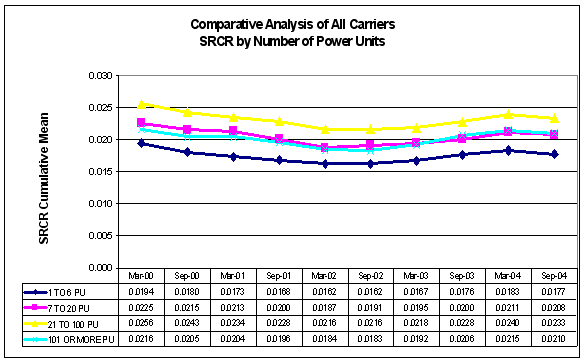
Figure 2-2: SRCR Comparative Analysis-By Number of Power UnitsD
The SRCR metric shows that although there has been an increase in the cumulative mean over the last several SafeStat runs, it has most recently decreased by 2.4% from the previous period. The SRCR has decreased by 6.7% since the March 2000 baseline SafeStat run.
All carrier groups by number of power units have improved since the March 2000 baseline SafeStat run. Since March 2000, the 21 to 100 and 1 to 6 power unit carriers have improved the most, with a decrease in the SRCR of 8.9% and 8.7%, respectively. Since March, 2000, the 101 or more power unit carriers have improved the least with a decrease in the SRCR of 2.9%. The 21 to 100 and 1 to 6 power unit carrier groups also improved the most since March, 2004, decreasing by 3.1% and 2.7%, respectively.
| Metrics to Measure Progress | Study Type | Power Unit Range | % Change from previous period (March 2004) | % Change from baseline (March 2000) | Number of Carriers (September 2004) |
|---|---|---|---|---|---|
| SRCR | Comparative Analysis | -2.4% | -6.7% | 626,594 | |
| Comparative Analysis by Number of Power Units | 1 to 6 | -3.1% | -8.6% | 548,944 | |
| 7 to 20 | -1.6% | -7.9% | 54,609 | ||
| 21 to 100 | -2.7% | -8.9% | 19,139 | ||
| 101 or more | -2.1% | -2.9% | 3,902 |
A comparative analysis of driver violation-based metrics was used to track FMCSA progress in meeting the objective that all commercial motor vehicle drivers are fully qualified, safe, alert and healthy. The following metrics were calculated over the various SafeStat runs: Driver Inspection Measure (DIM) and Moving Violations Measure (MVM) as well as the Driver Out-of-Service (DOOS) rate, the Hours-of-Service (HOS) violation rate, and the Commercial Driver License (CDL) violation rate. A peer-group analysis of 50th and 75th percentile values for the DIM and MVM was also carried out. Additionally, the DOOS rate from inspections performed on large trucks following involvement in a crash was calculated on an annual basis. Refer to Table 3-1 for a summary of the metrics selected and the analysis conducted.
| Safety Objective | Carrier Population | Metrics to Measure Progress | Comparative Analysis | Peer Group Analysis |
|---|---|---|---|---|
| All commercial motor vehicle drivers are fully qualified, safe, alert and healthy | All Carriers | DIM | X | X |
| MVN | X | X | ||
| DOOS | X | |||
| HOS Violation Rate | X | |||
| CDL Violation Rate | X | |||
| Post Crash Inspection DOOS (PCI-DOOS) Rate | By Year |
The DIM is computed in SafeStat using driver roadside inspection data from inspections performed within the last 30 months. SafeStat calculates the DIM for carriers that have had a minimum of three driver inspections. To compute a DIM, SafeStat time-weights each driver OOS inspection by its age and time-weights the number of DOOS violations found. The sum of these time-weighted numbers (TWNs) is divided by the sum of the time-weighted number (TWN) of driver inspections. The formula for the cumulative mean DIM can be represented as follows:
Cumulative Mean (DIM) = (STWN of Drivers Placed OOS +STWN of Driver OOS Violations)/(STWN of Driver Inspections)
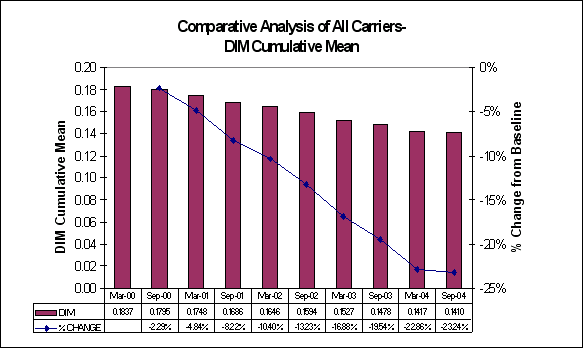
Comparative and peer group analyses were performed on the DIM. Both studies used SafeStat semi-annual runs between March 2000 and September 2004. Figure 3-1 shows the DIM cumulative mean of all carriers with three or more driver inspections has decreased significantly. The DIM shows a net decrease over the examined time period of 23.24%.
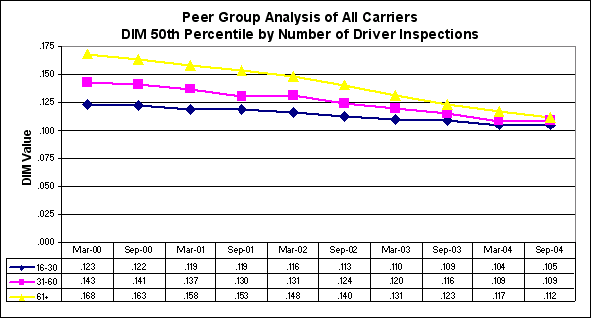
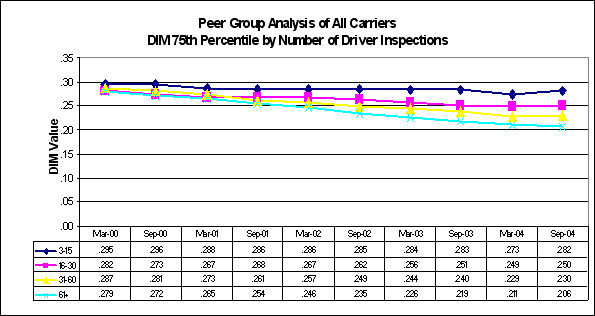
The peer group analysis for the DIM was conducted by grouping carriers with similar numbers of inspections using the same peer grouping as SafeStat (i.e., carriers with 3-15, 16-30, 31-60, and 61+ driver inspections). The peer group comparisons show a decreasing trend for carriers with 61+ driver inspections in the latest run. For the other groupings, the DIM value has remained constant or is increasing slightly. In Figure 3-2, 50th percentile values have decreased in the range of 15% to 33% since the baseline March 2000 SafeStat run. The DIM 75th percentile values in Figure 3-3 shows a similar trend. The higher the number of inspections, the higher the decrease in values; for example, carriers in the 61+ inspection group, for the 75th percentile, had a decrease of about 26% compared to around 4% for the 3-15 inspection group. Both the 50th and 75th percentile values show that the carriers with a greater number of inspections demonstrated a higher level of improvement.
 D
D
Figure 3-1: DIM Cumulative Mean - All Carriers
 D
D
Figure 3-2: DIM Peer Group Analysis - 50th Percentile
 D
D
Figure 3-3: DIM Peer Group Analysis - 50th Percentile
The MVM is calculated in SafeStat using selected moving violations recorded in conjunction with roadside inspections during the past 30 months. SafeStat weights each moving violation by its age for carriers with a minimum of three moving violations, sums the weighted counts, and then divides the weighted violations by the number of drivers to obtain the MVM. The cumulative mean MVM is calculated without the TWN of moving violations:
Cumulative Mean (MVM) = SMoving Violations/SDrivers
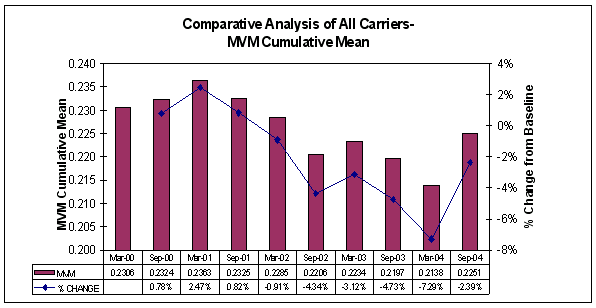
Comparative and peer group analyses were performed on the MVM. Both studies used SafeStat semi-annual runs between March 2000 and September 2004. Figure 3-4 shows the MVM cumulative mean of all carriers with three or more moving violations increasing slightly from March 2000 to March 2001 and decreasing slightly from March 2001 to September 2002. There was a slight increase between September 2002 and March 2003, followed by a decrease over two periods. The last period showed an increase as a result of both more moving violations and fewer drivers in September 2004 as compared to March 2004. The overall decrease in MVM over the entire period is -2.39%.
 D
D
Figure 3-4: MVM Cumulative Mean - All Carriers
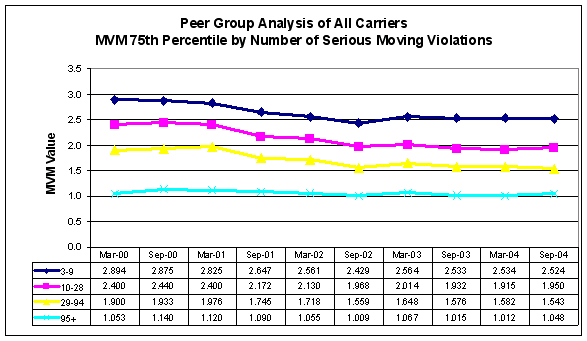
The peer group analysis for the MVM was conducted by grouping carriers with similar numbers of moving violations using the same peer grouping in SafeStat (i.e., carriers with 3-9, 10-28, 29-94, and 95+ moving violations). The 50th percentile 3-9 and 95+ peer groups show an initial increase from March 2000 to September 2000 followed by a decreasing trend through September 2002. Both peer groups experience increases in March 2003. The 50th percentile group experiences increases in March 2003, followed by a decrease and then increases in March 2004 and September 2004. The 95+ group ended at 7.4% above the March 2000 baseline. The 10-28 and 29-94 peer groups showed an increase in the initial period followed by decreases through September 2002. Both showed increases in March 2003, followed by a mixed result of increases and decreases. Both groups ended below baseline values. The 75th percentile peer groups follow a similar trend, but all end below their baseline values.
 D
D
Figure 3-5: MVN Peer Group Analysis - 50th Percentile
 D
D
Figure 3-6: MVN Peer Group Analysis - 75th Percentile
Cumulative Mean (DOOS) = S(Number of DOOS Inspections)/S(Number of Driver Inspections)
The following figure shows that the DOOS rate has been steadily decreasing. The total decrease in the DOOS rate between the baseline date of March 2000 and September 2004 was 22.72%.
 D
D
Figure 3-7: DOOS Cumulative Mean- All Carriers
The HOS violation rate is the number of hours of service out-of-service (OOS) violations found in driver roadside inspections over the past 30 months divided by the number of driver inspections. Carriers that have at least one inspection are included. This measure can be calculated according to the following formula:
Cumulative Mean (HOS) = S(HOS OOS Inspection Violations)/S(Number of Driver Inspections)
The data for this metric were not available prior to September 2001. Figure 3-8 shows that the number of HOS OOS violations per thousand driver inspections decreased from nearly 73 in September 2001 to almost 62 in September 2004. This represents a 15% drop in the HOS OOS violation rate. Historically, the HOS OOS violation rate dropped approximately 3% from period to period, except in the period between March 2004 and September 2004. Although it is likely that the most recent HOS regulation change that went into effect on January 1, 2004 has influenced this rate, it is unclear how or to what extent.
 D
D
Figure 3-8: Hours-of-Service Violation Rate
The CDL violation rate is the number of CDL out-of-service violations found in driver roadside inspections over the past 30 months divided by the number of driver inspections for the entire carrier population. Carriers with one or more inspections are included. This measure is calculated according to the following formula:
Cumulative Mean (CDL) = S(CDL OOS Inspection Violations)/S(Number of Driver Inspections)
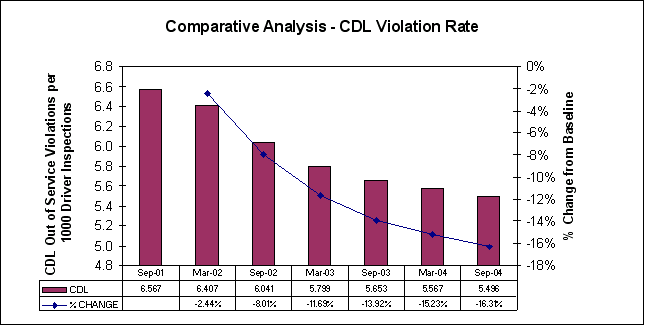
The data for this metric were not available prior to March 2001. Overall, the CDL violation rate has dropped by 16.31% from the September 2001 run to the latest run in September 2004, as shown in Figure 3-9.
 D
D
Figure 3-9: CDL Violation Rate
The Post Crash Inspection DOOS is based on the results of the subset of inspections conducted on drivers after being involved in a reportable crash. The PCI-DOOS is the fraction of post-crash inspections with Driver OOS violations. The formula for calculating this is:
Cumulative Mean (Post Crash Inspection DOOS) = S(Number of Post Crash Driver Inspections with Driver OOS Violations)/S(Number of Post Crash Driver Inspections)
The analysis of driver violations during post crash inspections is based on MCMIS data in September 2004 and is calculated on an annual basis. The results may change in subsequent releases of this report since additional inspections may be reported. The post crash driver OOS rate and the percentage of post crash inspections with any driver violations have show little fluctuation over the 4 years.
| Year | % Of Post Crash Inspections with Driver OOS Violations | % With any Driver Violations |
|---|---|---|
| 2000 | 10.9 | 42.8 |
| 2001 | 10.3 | 42.0 |
| 2002 | 10.2 | 42.0 |
| 2003 | 10.2 | 41.3 |
All metrics used to measure progress of the safety objective "All Commercial Motor Vehicle Drivers are Fully Qualified, Safe, Alert and Healthy", with the exception of the 50th percentile 95+ group, show a decrease from the March 2000 baseline to the September 2004 value (see Table 3-3). In the most recent periods, the MVM peer groups analysis shows a flattening of the metric. The MVM cumulative mean shows a decrease for two SafeStat runs, followed by an increase in the latest run due to an increase in moving violations but a decrease in drivers. This indicates that the industry is not improving at this time. As with state reported crashes, the reporting levels of moving violations by states may be affecting the results. However it should be noted that over the last three years (2002-2004), approximately the same percent of roadside inspections have resulted from a traffic enforcement stop each year. Additionally, it is likely that the HOS regulation change effective January 1, 2004 has influenced these results in an indeterminate way.
The remaining metrics show a mixed trend for driver violation rates. Although the DIM cumulative mean and the DIM value for carriers with 61+ driver inspections are both improving, the other carrier peer groups metrics have flattened out in the latest period. Also, the HOS and Post Crash Inspection DOOS cumulative means have shown a flattening of the metrics in the latest SafeStat run. Overall, however, assuming that fewer driver violations are being discovered due to improved industry compliance with the FMCSRs, results indicate that there is progress in meeting the objective of all CMV drivers being qualified, safe, alert and healthy.
| Metrics to Measure Progress | Study Type | Peer Grouping | % Change from the previous period (March 2004) | % Change from baseline (March 2000) |
|---|---|---|---|---|
| DIM | Comparative Analysis | -.5% | -23.24% | |
| Peer Grouping by number of inspections 50th Percentile | 3-15 | N/A | N/A | |
| 16-30 | 0.5% | -14.6% | ||
| 31-60 | 0.4% | -23.8% | ||
| 61+ | -4.4% | -33.3% | ||
| Peer Group by number of inspections 75th Percentile | 3-15 | 3.2% | -4.4% | |
| 16-30 | 0.5% | -11.3% | ||
| 31-60 | 0.5% | -19.9% | ||
| 61+ | -2.4% | -26.2% | ||
| MVM | Comparative Analysis | 5.3% | -2.39% | |
| Peer Group by number of violations 50th percentile | 3-9 | 0.2% | -4.0% | |
| 10-28 | 2.5% | -11.7% | ||
| 29-94 | 2.6% | -14.0% | ||
| 95+ | 3.3% | 7.4% | ||
| Peer Group by number of moving violations 75th Percentile | 3-9 | -0.4% | -12.8% | |
| 10-28 | 1.8% | -18.8% | ||
| 29-94 | -2.5% | -18.8% | ||
| 95+ | 3.6% | -0.5% | ||
| DOOS | Comparative Analysis | -2.4% | -22.72% | |
| HOS Viol. Rate | Comparative Analysis | 0.3% | -15.26% | |
| CDL Viol. Rate | Comparative Analysis | -1.3% | -16.31% | |
| Post Crash Inspection DOOS | Comparative Analysis | 0.1% | -7.2% |
A comparative analysis of fatal crash metrics was used to track progress in meeting the objective of improving the safety and performance of non-commercial drivers with respect to trucks. FARS data were used to measure the number of fatal crashes involving a single large truck and a single passenger vehicle, and the number of those fatal crashes where passenger vehicle driver factors were recorded. Passenger vehicle driver factors are noted by the officer at the scene of the crash, based on the officer's judgment. Such factors describe the condition and judgment of the passenger driver that could have contributed toward the crash.
| Safety Objective | Carrier Population | Metrics to Measure Progress | Comparative Analysis |
|---|---|---|---|
| Improve the safety and performance of non-commercial drivers with respect to trucks. | Carriers involved in fatal Large Truck/Passenger Vehicle Crashes | Number of Crashes | By Year |
| Crashes w/ Passenger Vehicle Driver Factors | By Year |
The number of single passenger vehicle/single large truck crashes was calculated on an annual basis for calendar years 2000-2003. These crashes involved one large truck and one single passenger vehicle. Table 4-2 shows that the number of single passenger vehicle/single large truck crashes has decreased by 8.6% from 2710 to 2476. Also, the number of such crashes with passenger vehicle driver factors was calculated. On an absolute basis, the number the passenger vehicle driver related factors recorded dropped from 2230 to 2094 between 2000 and 2003, or an improvement of 6.1%. The percentage of crashes with passenger vehicle driver factors recorded increased from 83.7% to 84.6%.
| Fatal Crashes | 2000 | 2001 | 2002 | 2003 |
|---|---|---|---|---|
| Total Single Passenger Vehicles/Single Large Truck Crashes | 2710 | 2585 | 2539 | 2476 |
| Crashes with Passenger Vehicle Driver-Related Factors Recorded | 2230 | 2116 | 2126 | 2094 |
| % With Driver Factors Recorded For Passenger Vehicle Driver | 82.3% | 81.9% | 83.7% | 84.6% |
There was a reduction in the number of single passenger/single large truck crashes of 8.6% and a reduction in the number of such crashes where passenger vehicle driver factors were recorded of 6.1% from 2000-2003. This shows progress in reducing the number of single passenger vehicle/single large truck crashes and the number of passenger vehicle driver related factors recorded. However, over the same time period the percentage of crashes with passenger vehicle driver factors recorded has increased.
A comparative analysis of compliance review (CR) based metrics was undertaken to track FMCSA's progress in meeting the objective of improving safety performance through encouraging refined and enhance motor carrier safety management systems. Both federal and state compliance reviews were included. The comparative analysis examined the cumulative mean of the Driver Review Measure (DRM) and Safety Management Review Measure (SMRM) and the percentage of CRs with no violations of acute or critical regulations.
| Safety Objective | Carrier Population | Metrics to Measure Progress | Comparative Analysis |
|---|---|---|---|
| Improve the overall safety performance of the motor carrier industry through refined and enhanced management systems. | All Carriers with Compliance Reviews | DRM | X |
| SMRM | X | ||
| % CRs with no acute critical violations | X |
The DRM is calculated in SafeStat using the results from CRs performed within the last 18 months. SafeStat quantifies the number and severity of violations of driver-related acute/critical regulations cited at a carrier's most recent compliance review as a DRM value. Carriers that did not receive an acute or critical violation are given a DRM value of zero. The cumulative mean DRM is calculated according to the formula:
Cumulative Mean (DRM)= SDRM/S (Number of Carriers)
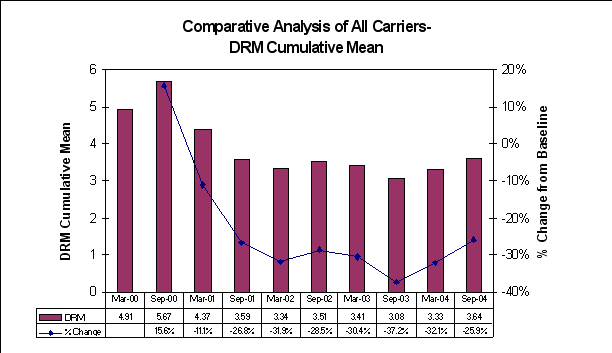
A comparative analysis of the cumulative mean DRM was conducted using SafeStat semi-annual runs from the March 2000 (baseline) to September 2004 for the population of carriers with a CR. The results show an initial increase in the DRM mean of 15.62% from March 2000 to September 2000 followed by a decreasing trend. Since March 2002 the DRM cumulative mean has shown some reduction but has remained between approximately 3.0 and 3.6. The net decrease from the baseline to September 2004 in the cumulative mean was 25.94%.
 D
D
Figure 5-1: DRM Cumulative Mean - All Carriers
The SMRM is calculated in SafeStat using the results from CRs performed within the last 18 months. SafeStat quantifies the number and severity of violations of safety management-related acute/critical regulations cited as a carrier's most recent compliance review as an SMRM value. Carriers that did not receive an acute or critical violation are given an SMRM value of zero. The following formula is used to calculate the cumulative mean SMRM:
Cumulative Mean (SMRM)= SSMRM/S (Number of Carriers)
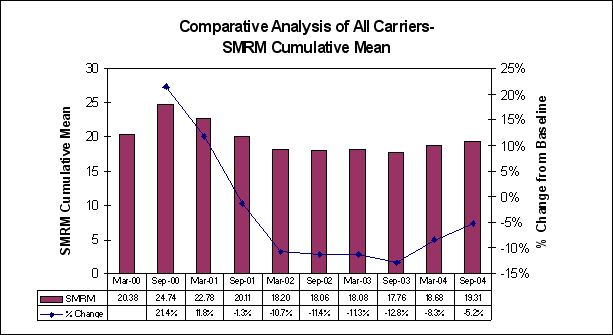
A comparative analysis of the cumulative mean SMRM was conducted using the SafeStat semi-annual runs from the March 2000 (baseline) to September 2004 for the population of carriers with a CR. The results show a similar trend to the DRM, with an initial increase in the SMRM cumulative mean from March 2000 to September 2000. After September 2000, the SMRM showed a steady decrease and since March 20002 has remained between 17-19. March 2004 showed the first sizable (~4%) increase with the SMRM moving to 18.68. The net decrease from March 2000 to September 2004 in the cumulative mean was 5.2%.
 D
D
Figure 5-2: SMRM Cumulative Mean - All Carriers
The percent of CRs without any acute or critical violations was measured on an annual basis. Table 5-2 shows that the percentage of CRs with no acute or critical violations has increased between 2000 and 2003 from 42.5% to 48.2%.
| 2000 | 2001 | 2002 | 2003 | |
|---|---|---|---|---|
| Number of Compliance Reviews | 13459 | 11406 | 12692 | 11953 |
| Number with Acute/Critical Violations | 7745 | 6105 | 6687 | 6187 |
| Number without Acute/Critical Violations | 5714 | 5301 | 6005 | 5766 |
| % without Acute/Critical Violations | 42.5% | 46.5% | 47.3% | 48.2% |
All of the metrics used to measure progress of the safety objective "Improving the Overall Safety Performance of the Motor Carrier Industry Through Refined and Enhanced Management Systems" show a decrease from the March 2000 baseline value to September 2004. Assuming that the thoroughness of the CRs conducted and the selection criteria for carriers with CRs are consistent over the analysis, the results indicate that there is progress in meeting this safety objective.
FMCSA identifies carriers as being high safety risks based on their SafeStat results. The group of carriers with the worst performance and compliance according to the SafeStat results are known as "Category A and B" carriers. FMCSA subsequently targets these high-risk carriers for its safety initiatives, such as CRs, to encourage the carriers to improve their safety fitness. Comparative and longitudinal analyses of various safety metrics were conducted to examine the safety performance of the Category A and B carriers to determine FMCSA's progress in meeting its objective of increasing the safety performance of the worst offenders to meet the norm. In addition to these analyses, other longitudinal analyses were performed on the Inspection Selection System (ISS) "inspect" carriers. Table 6-1 summarizes the metrics used and the analyses performed. Formulas used for calculating these metrics are described below.
| Safety Goal | Carrier Population | Metrics to Measure Progress | Comparative Analysis | Longitudinal Analysis |
|---|---|---|---|---|
| Increase the safety performance of the worst offenders to meet the norm. | AB Carriers | AIM | X | X |
| MVM | X | X | ||
| DIM | X | X | ||
| VIM | X | X | ||
| DRM | X | X | ||
| SMRM | X | X | ||
| DOOS | X | X | ||
| VOOS | X | X | ||
| ISS Inspect Carriers | SRCR | X | ||
| DOOS | X | |||
| VOOS | X |
In most cases, the metrics used in this section have already been explained in previous sections. The only difference in this case are the A and B carriers and/or ISS carriers. Below are the metrics not previously described.
The AIM cumulative mean for A and B carriers can be calculated by considering the A and B carriers with one or more power units and more than one accident, according to the following formula:
Cumulative Mean (AIM) = STCTWC/S(Power Units)
The VIM cumulative mean for A and B carriers is calculated by using the A and B carriers with more than two vehicle inspections, according to the formula:
Cumulative Mean (VIM) = (STWN of Vehicle OOS Inspections + STWN of Vehicle OOS Violations)/(STWN of Vehicle Inspections)
The VOOS cumulative mean for A and B carriers is calculated by using the A and B carriers with one or more vehicle inspections, according to the formula:
Cumulative Mean (VOOS) = S(Number of VOOS Inspections)/S(Number of Vehicle Inspections)
The VOOS cumulative mean for ISS carriers can be calculated by using the ISS carriers with one or more vehicle inspections, according to the formula described above.
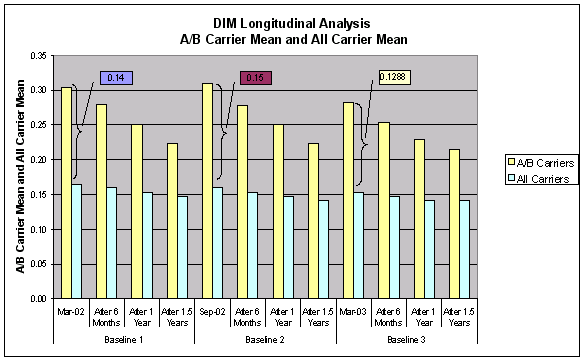
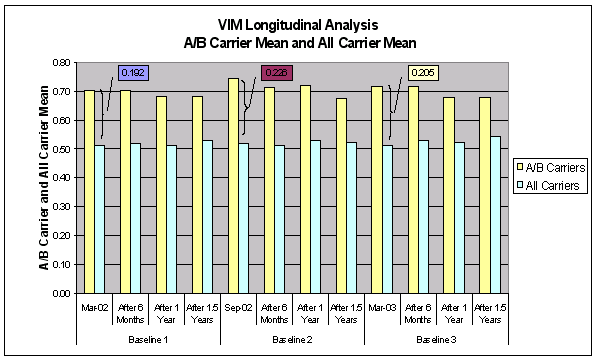
A longitudinal analysis was conducted on SafeStat Category A and B carriers. This analysis tracks the performance of the selected carrier population (namely the Category A and B carriers of a specific SafeStat run). A baseline carrier population of Category A and B carriers was selected for a SafeStat run and the cumulative mean of the metrics for that specific population are tracked over following SafeStat runs. These cumulative means are then compared to the cumulative mean of all carriers to determine how A/B carriers perform over time with respect to the norm.
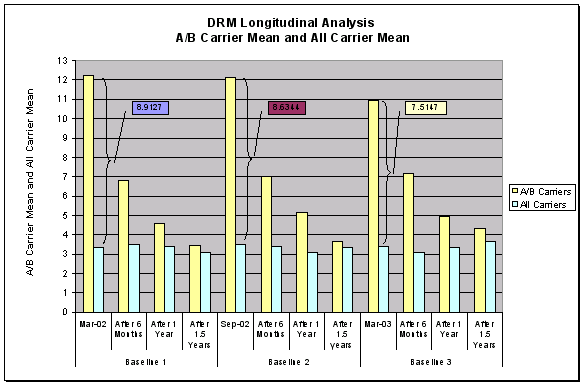
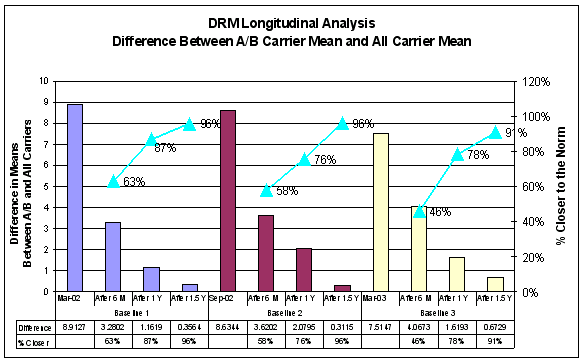
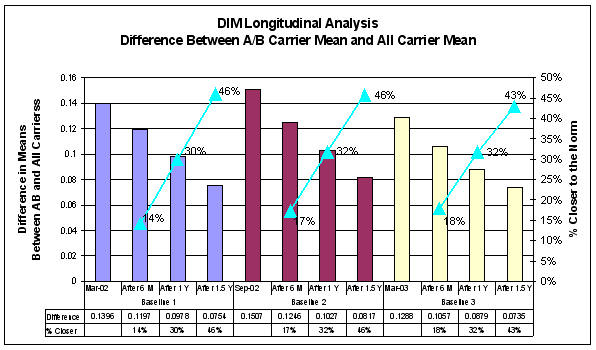
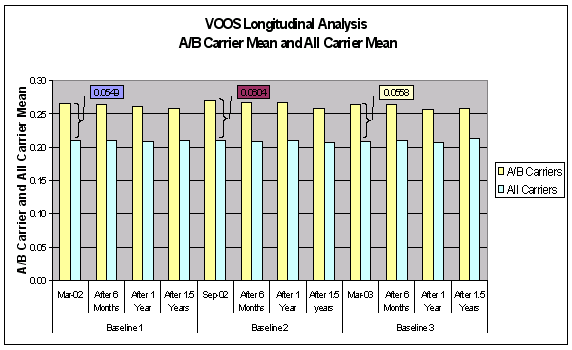
Three baseline groups of Category A and B carriers were identified from the SafeStat March 2002 (baseline 1), September 2002 (baseline 2) and March 2003 (baseline 3) runs. Each baseline group was then tracked over the next six months, year, and year-and-a-half. Figure 6-1 shows the A/B carrier mean and all carrier means for the base periods and the subsequent periods. The difference between the A/B and all carrier means is highlighted for each baseline. Figure 6-2 shows the difference between the DRM of A/B carrier and all carriers for each baseline period and the periods over the next six months, year, and year-and-a-half. For each of the three baselines dramatic improvements in the DRM were observed over the following 1.5 years. In all cases by the end of the observation period the A/B carrier mean was either 96% or 91% closer to the mean of all carriers. A similar analysis was conducted for the remaining measures. Graphs for each of these, along with the supporting data, are presented in Appendix A. A summary of the results can be found in Table 6-2 below.
 D
D
Figure 6-1: Longitudinal Analysis of DRM- A/B Carrier Mean and All Carrier Mean
 D
D
Figure 6-2: Longitudinal Analysis of DRM- Difference Between A/B Carriers and All Carriers
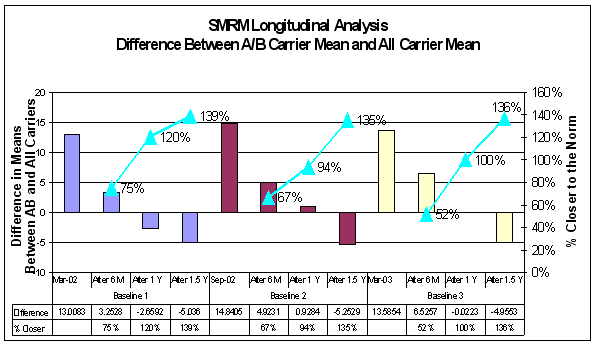
All measures show improvements after 1.5 years, with the SMRM showing the largest improvement in the difference between the A/B carrier mean and the all carrier mean with an average of 136% closer to the mean for the three baselines. The smallest improvement in the percent reduction is shown in the VOOS and MVM, with average improvements of 16% and 22%, respectively, closer to the norm for the three baselines after 1.5 years.
| Measure | % Closer to the Norm After 1.5 Years | ||
|---|---|---|---|
| March 2002 (Baseline 1) | September 2002 (Baseline 2) | March 2003 (Baseline 3) | |
| AIM | 40% | 41% | 33% |
| MVM | 14% | 30% | 22% |
| DIM | 46% | 46% | 43% |
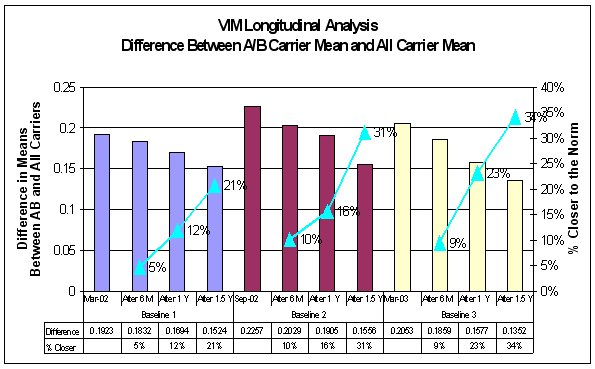
| VIM | 21% | 31% | 34% |
| DRM | 96% | 96% | 91% |
| SMRM | 139% | 135% | 136% |
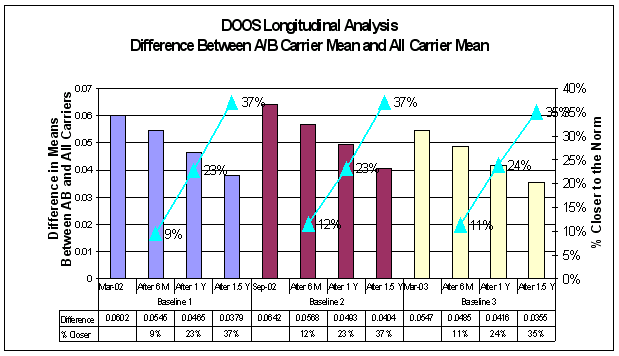
| DOOS | 37% | 37% | 35% |
| VOOS | 12% | 16% | 19% |
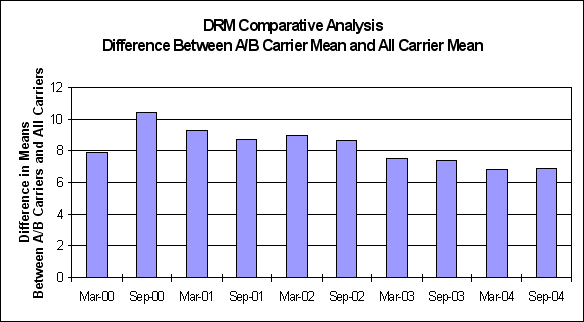
A comparative analysis was conducted on SafeStat Category A and B carriers. First the Category A and B carriers were identified for each of the March and September semi-annual SafeStat runs from 2000 to 2004, and then metrics were calculated for each set of Category A and B carriers. To compare the performance of A and B carriers with respect of the norm, the difference for each measure between the A and B carriers mean and all carriers mean was determined. A decrease in the difference would denote an improved safety performance of A and B carriers with respect to the norm. An increase in the difference would show that A and B carriers were performing worse with respect to the norm. Figure 6-1 shows an example of this. In March 2000, the mean DRM for A and B carriers was approximately 8 points higher than that of all carriers. In September 2000 this difference increased to greater than 10 points, which shows that the A and B carriers safety performance decreased (worsened) when compared to the entire carrier population with a DRM. Since March 2003 the difference between A and B carriers and all carriers has been approximately 7 points. This reflects an improving relative level of driver factor compliance for the Category A and B carriers compared to the norm during that timeframe.
 D
D
Figure 6-3: Comparative Analysis of DRM- Difference Between A/B Carrier Mean and All Carrier Mean
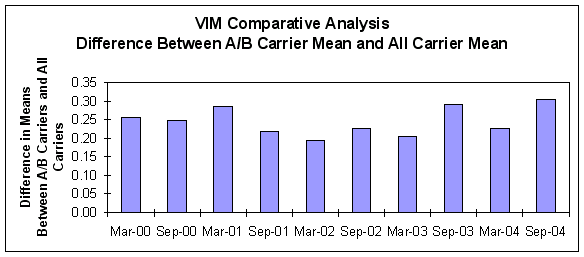
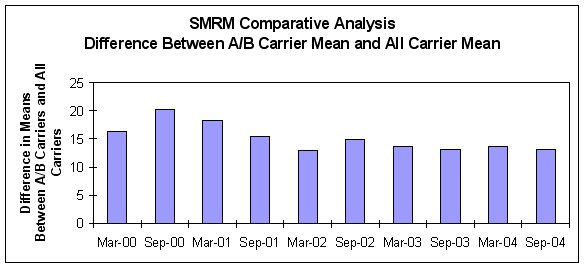
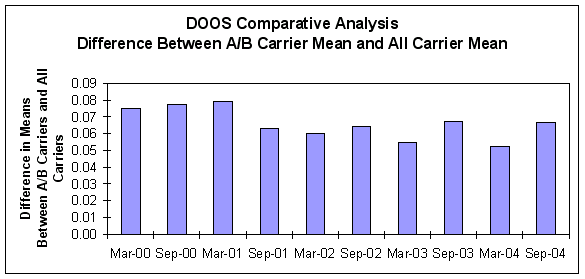
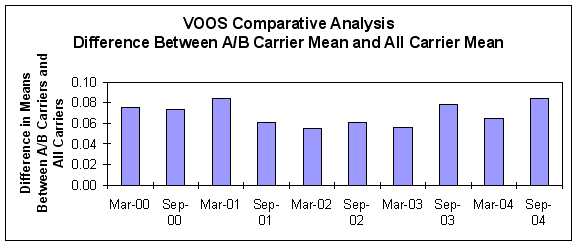
A similar analysis was performed for the rest of the measures. Figures for each measure, along with the supporting data, can be found in Appendix A. A summary of findings is presented in Table 6-3 below. Half of the measures show a modest improvement of the A and B carriers moving closer to the norm, with decreases in the range of 6.3% to 19.8% when compared to the March 2000 baseline. The AIM shows the most worsening in the difference between the A/B carrier mean and the all carrier mean, with an increase of 62% when compared to the March 2000 baseline. All of the measures, except for the SMRM, increased over the last period. The MVM increased the most by 47.1% from March 2004 to September 2004.
| Measure | % Change from previous period (March 2004) | % Change from the baseline (March 2000) |
|---|---|---|
| AIM | +28.4% | +62.2% |
| MVM | +47.1% | +4.1% |
| DIM | +29.4% | -6.3% |
| VIM | +33.9% | +19.1% |
| DRM | +1.2% | -13.1% |
| SMRM | -4.7% | -19.8% |
| DOOS | +26.2% | -11.2% |
| VOOS | +31.0% | +11.4% |
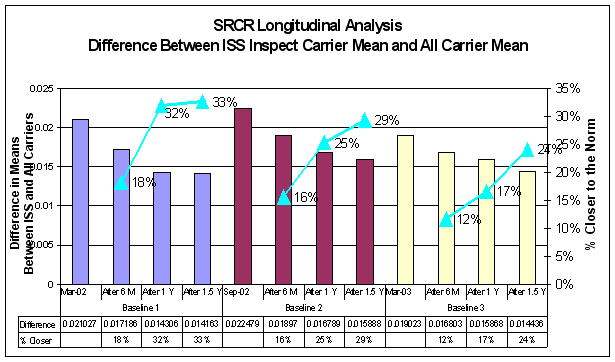
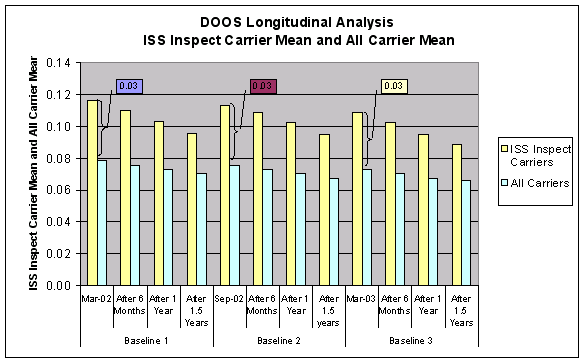
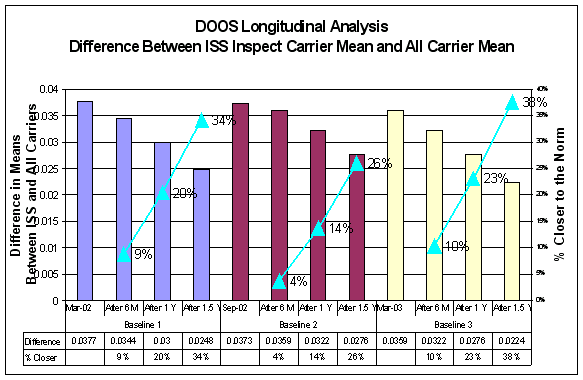
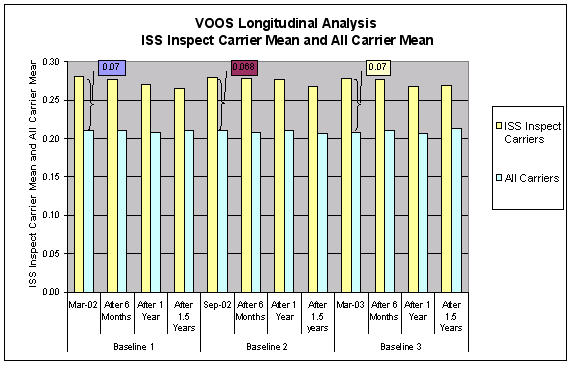
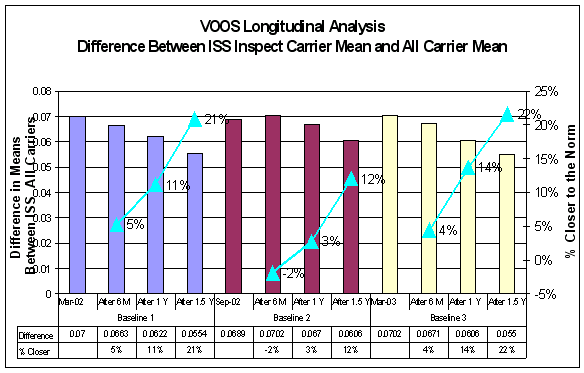
The Inspection Selection System (ISS) provides a recommendation to roadside inspectors on whether or not to inspect a vehicle and/or driver based on the safety status of the carrier. The main goal of ISS is to prioritize carriers with poor safety performance. Some additional carriers are prioritized for inspection if they have not had previous inspections. Carriers with the highest priority are given a recommendation of "inspect". The ISS recommendations are updated with each SafeStat run. A longitudinal analysis was conducted on ISS "inspect" carriers, i.e. carriers with poor safety performance, in order to track the performance of this group of carriers over time. A baseline carrier population of ISS inspect carriers was selected for a SafeStat run and the cumulative mean of the metrics for that specific population were tracked over following SafeStat runs. These values are then compared to the mean of all carriers for each measure (DOOS, VOOS and SRCR). This technique shows whether or not these carriers improved with respect to the norm over time.
Three baseline groups of ISS inspect carriers were identified from the SafeStat runs of March 2002 (baseline 1), September 2002 (baseline 2) and March 2003 (baseline 3). Each baseline group was then tracked over the next six months, year, and year-and-a-half. Table 6-4 shows that all baselines were closer to the norm after 1.5 years.
| Measure | % Closer to the Norm After 1.5 Years | ||
|---|---|---|---|
| March 2002 (Baseline 1) | September 2002 (Baseline 2) | March 2003 (Baseline 3) | |
| SRCR | 33% | 29% | 24% |
| DOOS | 34% | 26% | 38% |
| VOOS | 21% | 12% | 22% |
Although the SRCR did not improve as much in the third baseline as it did in the first two baselines, the DOOS and VOOS did improve more in the third baseline.
Figure 6-3 shows the ISS carrier mean and all carrier means for the base periods and the subsequent periods, including highlighted differences for each baseline. Figure 6-4 shows this difference for each baseline group and shows how much closer the ISS carrier mean was to the all carrier mean as a percentage. The SRCR's trend has been to improve by a smaller percentage in each successive baseline; the SRCR begins at 33% closer to the all carrier mean after 1.5 years and ends at 24% closer to the mean after 1.5 years in the third baseline. The DOOS and VOOS exhibit a different trend, with the % closer to the all carrier mean decreasing in the second baseline and then increasing in the third. The DOOS is 38% closer to the mean after 1.5 years in baseline three, while the VOOS is 22% closer to the mean after 1.5 years in the third baseline.
 D
D
Figure 6-4: Longitudinal Analysis of SRCR- ISS Inspect Carrier Mean and All Carrier Mean
 D
D
Figure 6-5: Longitudinal Analysis of SRCR- Difference Between ISS Inspect Carrier Mean and All Carrier Mean
 D
D
Figure 6-6: Longitudinal Analysis of DOOS- ISS Inspect Carrier Mean and All Carrier Mean
 D
D
Figure 6-7: Longitudinal Analysis of DOOS- Difference Between ISS Inspect Carrier Mean and All Carrier Mean
 D
D
Figure 6-8: Longitudinal Analysis of VOOS- ISS Inspect Carrier Mean and All Carrier Mean
 D
D
Figure 6-9: Longitudinal Analysis of VOOS- Difference Between ISS Inspect Carrier Mean and All Carrier Mean
The longitudinal analyses of Category A and B carriers demonstrate that the worst offenders made solid improvements in safety over time with respect to all carriers. The comparative analysis of Category A and B carriers shows a mixed result for the groups of worst offenders, as defined by SafeStat. The difference between the A and B carrier mean and the all carrier mean for the AIM, the crash-related measures, has increased significantly by 62.2% since the March 2000 baseline. In contrast, the driver and safety management measures for the worst offender groups improved, with decreases in the range of 6.3% to 19.8% from the March 2000 baseline. The ISS inspect carriers also improved, though the crash-related measure, the SRCR, shows declining improvement over time. The results of these analyses indicate that there is progress in some areas toward meeting the objective of increasing the safety performance of the worst offenders to meet the norm.
A comparative analysis of vehicle violation-based metrics was used to track progress in meeting the objective that all commercial motor vehicle have optimum safety performance. The following metrics were calculated over the various SafeStat runs: Vehicle Inspection Measure (VIM) and the Vehicle Out-of-Service (VOOS) rate. A peer-group analysis of 50th and 75th percentile values for the VIM was also carried out. Additionally, the VOOS rate from inspections performed on large trucks following involvement in a crash was calculated on an annual basis. Refer to Table 7-1 for a summary of the metrics selected and the analysis conducted.
| Safety Goal | Carrier Population | Metrics to Measure Progress | Comparative Analysis | Peer Group Analysis |
|---|---|---|---|---|
| Commercial motor vehicles have optimum safety performance. | All Carriers | VIM | X | X |
| Vehicle Out-of-Service (VOOS) | X | |||
| Post Crash Inspection VOOS (PCI-VOOS) Rate | By Year |
The VIM is computed in SafeStat using vehicle roadside inspection data from inspections performed within the last 30 months. SafeStat calculates the VIM for carriers that have had a minimum of three vehicle inspections. SafeStat time weights inspection data to give more importance to recent inspections. To compute the VIM, SafeStat sums the time-weighted number of vehicle OOS inspections to the time-weighted number of vehicle OOS violations and then divides by the total time-weighted number of vehicle inspections:
Cumulative Mean (VIM) = (STWN of Vehicle OOS Inspections + STWN of Vehicle OOS Violations)/(STWN of Vehicle Inspections)
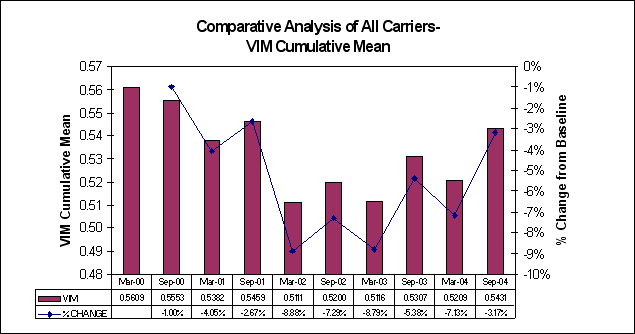
Comparative and peer group analyses were performed on the VIM. Both studies used SafeStat semi-annual runs between March 2000 and September 2004. Figure 7-1 shows the VIM cumulative mean of all carriers with three or more driver inspections has improved, as it decreased over the examined time period by 3.17%. However it should be noted that the last three runs showed increases over the previous three periods.
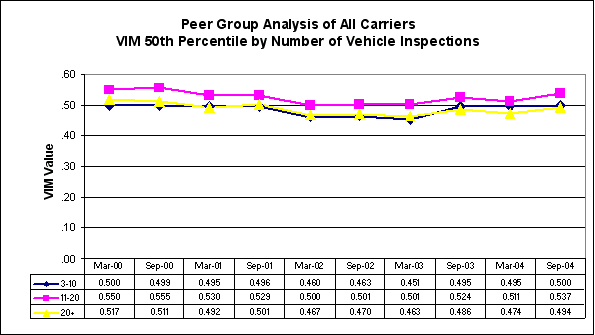
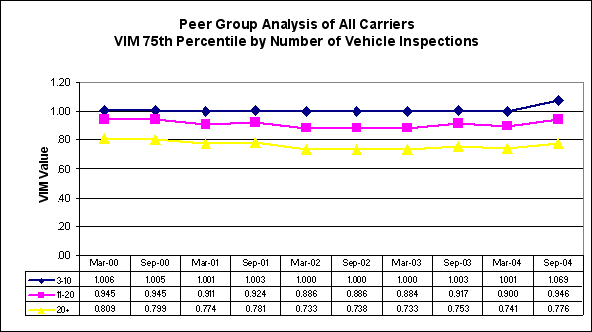
The peer group analysis for the VIM was conducted by grouping carriers with similar numbers of inspections using the same peer grouping in SafeStat (i.e., carriers with 3-10, 11-20, and 21+ vehicle inspections). Figures 7-2 and 7-3 show mixed results for VIM percentile values. Generally, those peer groups with the most vehicle inspections show the largest decrease since the baseline SafeStat run of March 200. The peer group with 21+ vehicle inspections showed the most improvement, decreasing by 4.4 %and 4.1% in the 50th percentile and 75th percentile values, respectively. The 3-10 vehicle inspection group showed no improvement since the baseline march 2000 SafeStat run and fared worse in the 75th percentile value with an increase of 6.3%.
 D
D
Figure 7-1: VIM Cumulative Mean- All Carriers
 D
D
Figure 7-2: VIM Peer Group Analysis- 50th Percentile
 D
D
Figure 7-3: VIM Peer Group Analysis- 75th Percentile
The VOOS rate is the total number of vehicle OOS inspections divided by the total number of vehicle inspections over the past 30 months for the entire carrier population. It is similar to the "cumulative mean VIM" but the VOOS rate is not time-weighted nor does it account for multiple VOOS violations from a single inspection. The population includes all carriers with one or more vehicle inspections. The formula for calculating the cumulative mean VOOS is:
Cumulative Mean (VOOS) = S(Number of VOOS Inspections)/S(Number of Vehicle Inspections)
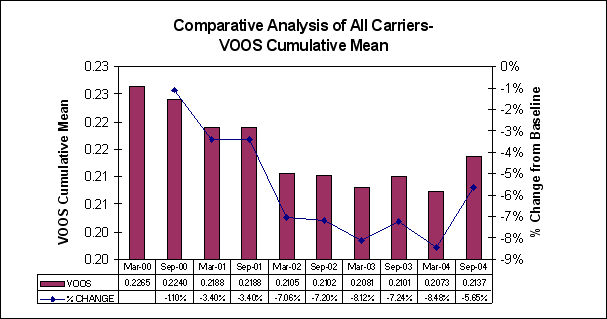
The following figure shows that the VOOS improved between March 2000 and March 2003, as it decreased by 8.12%. The September 2004 data shows the largest increase in the VOOS since the baseline date. However the VOOS rate still shows a 5.65% decrease since March 2000.
 D
D
Figure 7-4: Vehicle Out-Of-Service Rate
The Post Crash Inspection VOOS rate is based on the results of the subset of inspections conducted on the vehicles after they were involved in a reportable crash. The PCI-VOOS is the fraction of post-crash inspections with VOOS violations:
Cumulative Mean (Post Crash Inspection VOOS) = S(Number of Post Crash Vehicle Inspections with Vehicle OOS Violations)/S(Number of Post Crash Vehicle Inspections)
The analysis of vehicle violations during post crash inspections is based on MCMIS data in September 2004 and is calculated on an annual basis. The results may change in subsequent releases of this report since additional inspections may be reported. From 2000 until 2003, the PCI-VOOS has improved decreasing from 33.4% to 32.6%. The percentage of post crash inspections with any vehicle violations has not improved during the same period, as it increased from 61.9% to 63.3%.
| Year | % Of Post Crash Inspections with Vehicle OOS Violations | % With any Vehicle Violations |
|---|---|---|
| 2000 | 33.4 | 61.9 |
| 2001 | 33.0 | 63.2 |
| 2002 | 31.9 | 62.6 |
| 2003 | 32.6 | 63.3 |
All of the comparative metrics used to measure progress of the safety objective "Commercial Motor Vehicles have Optimum Safety Performance" show an improvement from the March 2000 baseline value to the September 2004 value (see Table 7-3). The peer metrics show mixed results, with the groups with the most inspections showing the most improvement. The VIM, VOOS, and Post Crash Inspection DOOS show an increase from the last period. This demonstrates that in the short-term, the metrics have increased. Over the long term, there is a decrease in the metrics, denoting a positive trend for this safety objective. Assuming that the lower number of vehicle violations are being discovered due to improved industry compliance with the FMCSRs, these results indicate that there is progress in meeting the objective of all CMVs having optimum safety performance.
| Metrics to Measure Progress | Study Type | Peer Grouping | % Change from the previous period (March 2004) | % Change from baseline (March 2000) |
|---|---|---|---|---|
| VIM | Comparative Analysis | 4.3% | -3.2% | |
| Peer Grouping by number of inspections50th Percentile | 3-10 | 1.0% | 0.0% | |
| 11-20 | 5.1% | -2.4% | ||
| 20+ | 4.2% | -4.4% | ||
| Peer Group by number of inspections 75th Percentile | 3-10 | 6.8% | 6.3% | |
| 11-20 | 5.1% | 0.1% | ||
| 20+ | 4.7% | -4.1% | ||
| VOOS | Comparative Analysis | 3.1% | -5.7% | |
| Post Crash Inspection VOOS | Comparative Analysis | 2.4% | -2.3% |
This report contains the results for nine SafeStat runs, from March 2000 to September 2004. A run is a snapshot in time of SafeStat's safety measures (results). Although results show movement in a positive direction for most metrics when compared to the March 2000 baseline, the trend over the more recent periods shows a leveling-off or worsening in most of the metrics. A summary of the results by FMCSA safety objective follows:
General Objective: Reduction in Commercial Motor Vehicle CrashesWhile the results in this report show that the FMCSA is making strides toward meeting its safety objective, when compared to baseline values, it is important to continue to monitor progress. This report shows the importance of continued monitoring. In the previous version of this report titled "Measuring FMCSA's Safety Objectives from year 2000 to 2002" all metrics showed clear improvements over the study period. This latest version shows mixed results. Further monitoring allows FMCSA to (1) observe the results of its efforts and (2) adjust its safety programs based on where the most improvement is needed. The results in this report are current through September 2004. Revisions of this document are planned that will contain updates of the results and further analysis of progress in attaining FMCSA's safety objectives.
| All Carriers | ||||||||
| AIM | MVM | DIM | VIM | DRM | SMRM | DOOS | VOOS | |
| Mar-00 | 0.1956 | 0.2306 | 0.1837 | 0.5609 | 4.91 | 20.38 | 0.0854 | 0.2265 |
| Sep-00 | 0.1732 | 0.2324 | 0.1795 | 0.5553 | 5.67 | 24.74 | 0.0847 | 0.2240 |
| Mar-01 | 0.1659 | 0.2363 | 0.1748 | 0.5382 | 4.37 | 22.78 | 0.0831 | 0.2188 |
| Sep-01 | 0.1473 | 0.2325 | 0.1686 | 0.5459 | 3.59 | 20.11 | 0.0805 | 0.2188 |
| Mar-02 | 0.1530 | 0.2285 | 0.1646 | 0.5111 | 3.34 | 18.20 | 0.0784 | 0.2105 |
| Sep-02 | 0.1469 | 0.2206 | 0.1594 | 0.5200 | 3.51 | 18.06 | 0.0758 | 0.2102 |
| Mar-03 | 0.1497 | 0.2234 | 0.1527 | 0.5116 | 3.41 | 18.08 | 0.0729 | 0.2081 |
| Sep-03 | 0.1606 | 0.2197 | 0.1478 | 0.5307 | 3.08 | 17.76 | 0.0706 | 0.2101 |
| Mar-04 | 0.1696 | 0.2138 | 0.1417 | 0.5209 | 3.33 | 18.68 | 0.0676 | 0.2073 |
| Sep-04 | 0.1839 | 0.2251 | 0.1410 | 0.5431 | 3.64 | 19.31 | 0.0660 | 0.2137 |
| A/B Carriers | ||||||||
| AIM | MVM | DIM | VIM | DRM | SMRM | DOOS | VOOS | |
| Mar-00 | 0.4519 | 0.5680 | 0.3557 | 0.8164 | 12.8300 | 36.6948 | 0.1602 | 0.3021 |
| Sep-00 | 0.4816 | 0.5823 | 0.3555 | 0.8015 | 16.0620 | 45.0585 | 0.1619 | 0.2970 |
| Mar-01 | 0.4553 | 0.6104 | 0.3562 | 0.8242 | 13.6316 | 41.0748 | 0.1620 | 0.3024 |
| Sep-01 | 0.3845 | 0.5149 | 0.3135 | 0.7649 | 12.2949 | 35.5117 | 0.1436 | 0.2798 |
| Mar-02 | 0.3700 | 0.4564 | 0.3042 | 0.7034 | 12.2543 | 31.2059 | 0.1386 | 0.2654 |
| Sep-02 | 0.3565 | 0.4399 | 0.3101 | 0.7457 | 12.1418 | 32.9036 | 0.1400 | 0.2706 |
| Mar-03 | 0.3829 | 0.4252 | 0.2815 | 0.7169 | 10.9296 | 31.6627 | 0.1276 | 0.2639 |
| Sep-03 | 0.5017 | 0.5732 | 0.3047 | 0.8204 | 10.5177 | 30.8551 | 0.1377 | 0.2882 |
| Mar-04 | 0.4934 | 0.4526 | 0.2662 | 0.7481 | 10.1383 | 32.4153 | 0.1202 | 0.2716 |
| Sep-04 | 0.5997 | 0.5763 | 0.3021 | 0.8473 | 10.5208 | 32.4095 | 0.1324 | 0.2979 |
| Difference (A/B Carriers - All Carriers) | ||||||||
| AIM | MVM | DIM | VIM | DRM | SMRM | DOOS | VOOS | |
| Mar-00 | 0.2563 | 0.3374 | 0.1720 | 0.2555 | 7.9217 | 16.3188 | 0.0748 | 0.0756 |
| Sep-00 | 0.3084 | 0.3499 | 0.1760 | 0.2462 | 10.3872 | 20.3221 | 0.0772 | 0.0730 |
| Mar-01 | 0.2894 | 0.3741 | 0.1814 | 0.2860 | 9.2666 | 18.2954 | 0.0789 | 0.0836 |
| Sep-01 | 0.2372 | 0.2824 | 0.1449 | 0.2190 | 8.7019 | 15.4056 | 0.0631 | 0.0610 |
| Mar-02 | 0.2170 | 0.2279 | 0.1396 | 0.1923 | 8.9127 | 13.0083 | 0.0602 | 0.0549 |
| Sep-02 | 0.2096 | 0.2193 | 0.1507 | 0.2257 | 8.6344 | 14.8405 | 0.0642 | 0.0604 |
| Mar-03 | 0.2332 | 0.2018 | 0.1288 | 0.2053 | 7.5147 | 13.5854 | 0.0547 | 0.0558 |
| Sep-03 | 0.3411 | 0.3535 | 0.1569 | 0.2897 | 7.4359 | 13.0921 | 0.0671 | 0.0781 |
| Mar-04 | 0.3238 | 0.2388 | 0.1245 | 0.2272 | 6.8065 | 13.7356 | 0.0526 | 0.0643 |
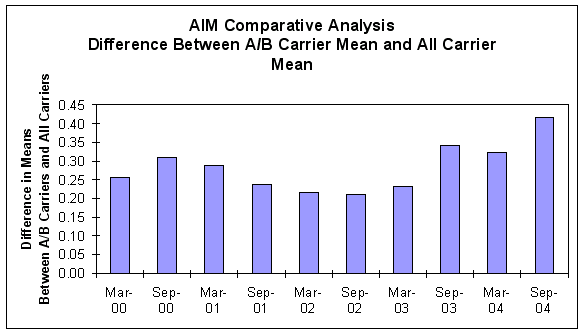
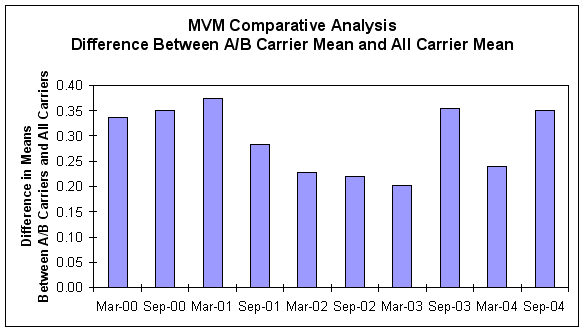
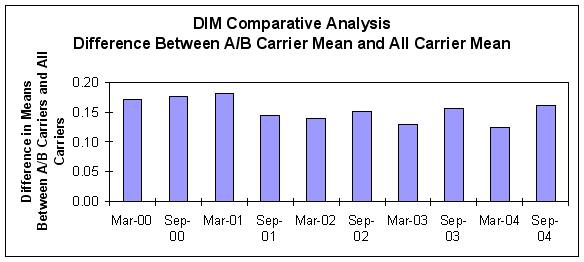
| Sep-04 | 0.4158 | 0.3512 | 0.1611 | 0.3042 | 6.8857 | 13.0946 | 0.0664 | 0.0842 |
 D
D
Figure A-1: Comparative Analysis of AIM- Difference Between A/B Carrier Mean and All Carrier Mean
 D
D
Figure A-2: Comparative Analysis of MVM- Difference Between A/B Carrier Mean and All Carrier Mean
 D
D
Figure A-3: Comparative Analysis of DIM- Difference Between A/B Carrier Mean and All Carrier Mean
 D
D
Figure A-4: Comparative Analysis of VIM- Difference Between A/B Carrier Mean and All Carrier Mean
 D
D
Figure A-5: Comparative Analysis of SMRM- Difference Between A/B Carrier Mean and All Carrier Mean
 D
D
Figure A-6: Comparative Analysis of DOOS- Difference Between A/B Carrier Mean and All Carrier Mean
 D
D
Figure A-7: Comparative Analysis of VOOS- Difference Between A/B Carrier Mean and All Carrier Mean
| Baseline | Base Value | After 6 months | After 1 year | After 1.5 years |
| AIM | ||||
| A/B Carriers | ||||
| 1 | 0.3700 | 0.3303 | 0.3065 | 0.2904 |
| 2 | 0.3565 | 0.3133 | 0.2920 | 0.2928 |
| 3 | 0.3829 | 0.3551 | 0.3513 | 0.3405 |
| All Carriers | ||||
| 1 | 0.1530 | 0.1469 | 0.1497 | 0.1606 |
| 2 | 0.1469 | 0.1497 | 0.1606 | 0.1696 |
| 3 | 0.1497 | 0.1606 | 0.1696 | 0.1839 |
| Difference (A/B Carriers - All Carriers) | ||||
| 1 | 0.2170 | 0.1834 | 0.1568 | 0.1298 |
| 2 | 0.2096 | 0.1636 | 0.1314 | 0.1232 |
| 3 | 0.2332 | 0.1945 | 0.1817 | 0.1566 |
| MVM | ||||
| A/B Carriers | ||||
| 1 | 0.4564 | 0.4512 | 0.4376 | 0.4162 |
| 2 | 0.4399 | 0.4119 | 0.3879 | 0.3679 |
| 3 | 0.4252 | 0.4076 | 0.3883 | 0.3830 |
| All Carriers | ||||
| 1 | 0.2285 | 0.2206 | 0.2234 | 0.2197 |
| 2 | 0.2206 | 0.2234 | 0.2197 | 0.2138 |
| 3 | 0.2234 | 0.2197 | 0.2138 | 0.2251 |
| Difference (A/B Carriers - All Carriers) | ||||
| 1 | 0.2279 | 0.2306 | 0.2142 | 0.1965 |
| 2 | 0.2193 | 0.1885 | 0.1682 | 0.1541 |
| 3 | 0.2018 | 0.1879 | 0.1745 | 0.1579 |
| DIM | ||||
| A/B Carriers | ||||
| 1 | 0.3042 | 0.2791 | 0.2505 | 0.2232 |
| 2 | 0.3101 | 0.2773 | 0.2505 | 0.2234 |
| 3 | 0.2815 | 0.2535 | 0.2296 | 0.2145 |
| All Carriers | ||||
| 1 | 0.1646 | 0.1594 | 0.1527 | 0.1478 |
| 2 | 0.1594 | 0.1527 | 0.1478 | 0.1417 |
| 3 | 0.1527 | 0.1478 | 0.1417 | 0.1410 |
| Difference (A/B Carriers - All Carriers) | ||||
| 1 | 0.1396 | 0.1197 | 0.0978 | 0.0754 |
| 2 | 0.1507 | 0.1246 | 0.1027 | 0.0817 |
| 3 | 0.1288 | 0.1057 | 0.0879 | 0.0735 |
| VIM | ||||
| A/B Carriers | ||||
| 1 | 0.7034 | 0.7032 | 0.6810 | 0.6831 |
| 2 | 0.7457 | 0.7145 | 0.7212 | 0.6765 |
| 3 | 0.7169 | 0.7166 | 0.6786 | 0.6783 |
| All Carriers | ||||
| 1 | 0.5111 | 0.5200 | 0.5116 | 0.5307 |
| 2 | 0.5200 | 0.5116 | 0.5307 | 0.5209 |
| 3 | 0.5116 | 0.5307 | 0.5209 | 0.5431 |
| Difference (A/B Carriers - All Carriers) | ||||
| 1 | 0.1923 | 0.1832 | 0.1694 | 0.1524 |
| 2 | 0.2257 | 0.2029 | 0.1905 | 0.1556 |
| 3 | 0.2053 | 0.1859 | 0.1577 | 0.1352 |
| DRM | ||||
| A/B Carriers | ||||
| 1 | 12.2543 | 6.7876 | 4.5768 | 3.4382 |
| 2 | 12.1418 | 7.0351 | 5.1613 | 3.6433 |
| 3 | 10.9296 | 7.1491 | 4.9511 | 4.3080 |
| All Carriers | ||||
| 1 | 3.3416 | 3.5074 | 3.4149 | 3.0818 |
| 2 | 3.5074 | 3.4149 | 3.0818 | 3.3318 |
| 3 | 3.4149 | 3.0818 | 3.3318 | 3.6351 |
| Difference (A/B Carriers - All Carriers) | ||||
| 1 | 8.9127 | 3.2802 | 1.1619 | 0.3564 |
| 2 | 8.6344 | 3.6202 | 2.0795 | 0.3115 |
| 3 | 7.5147 | 4.0673 | 1.6193 | 0.6729 |
| SMRM | ||||
| A/B Carriers | ||||
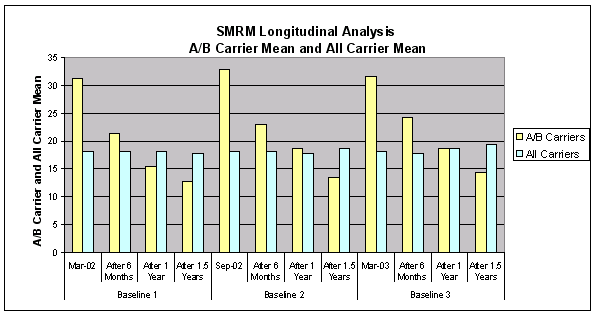
| 1 | 31.2059 | 21.3159 | 15.4181 | 12.7270 |
| 2 | 32.9036 | 23.0004 | 18.6914 | 13.4268 |
| 3 | 31.6627 | 24.2887 | 18.6574 | 14.3596 |
| All Carriers | ||||
| 1 | 18.1976 | 18.0631 | 18.0773 | 17.7630 |
| 2 | 18.0631 | 18.0773 | 17.7630 | 18.6797 |
| 3 | 18.0773 | 17.7630 | 18.6797 | 19.3149 |
| Difference (A/B Carriers - All Carriers) | ||||
| 1 | 13.0083 | 3.2528 | -2.6592 | -5.0360 |
| 2 | 14.8405 | 4.9231 | 0.9284 | -5.2529 |
| 3 | 13.5854 | 6.5257 | -0.0223 | -4.9553 |
| DOOS | ||||
| A/B Carriers | ||||
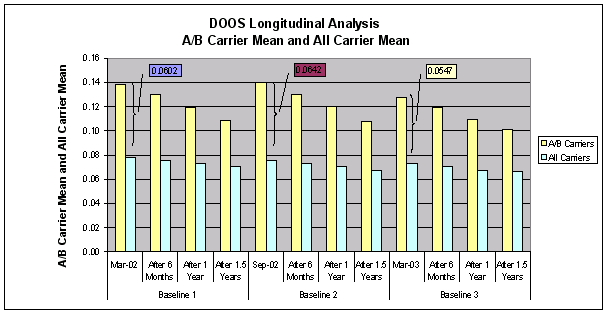
| 1 | 0.1386 | 0.1303 | 0.1194 | 0.1085 |
| 2 | 0.1400 | 0.1297 | 0.1199 | 0.1080 |
| 3 | 0.1276 | 0.1191 | 0.1092 | 0.1015 |
| All Carriers | ||||
| 1 | 0.0784 | 0.0758 | 0.0729 | 0.0706 |
| 2 | 0.0758 | 0.0729 | 0.0706 | 0.0676 |
| 3 | 0.0729 | 0.0706 | 0.0676 | 0.0660 |
| Difference (A/B Carriers - All Carriers) | ||||
| 1 | 0.0602 | 0.0545 | 0.0465 | 0.0379 |
| 2 | 0.0642 | 0.0568 | 0.0493 | 0.0404 |
| 3 | 0.0547 | 0.0485 | 0.0416 | 0.0355 |
| VOOS | ||||
| A/B Carriers | ||||
| 1 | 0.2654 | 0.2648 | 0.2613 | 0.2586 |
| 2 | 0.2706 | 0.2666 | 0.2666 | 0.2578 |
| 3 | 0.2639 | 0.2637 | 0.2573 | 0.2589 |
| All Carriers | ||||
| 1 | 0.2105 | 0.2102 | 0.2081 | 0.2101 |
| 2 | 0.2102 | 0.2081 | 0.2101 | 0.2073 |
| 3 | 0.2081 | 0.2101 | 0.2073 | 0.2137 |
| Difference (A/B Carriers - All Carriers) | ||||
| 1 | 0.0549 | 0.0546 | 0.0532 | 0.0485 |
| 2 | 0.0604 | 0.0585 | 0.0565 | 0.0505 |
| 3 | 0.0558 | 0.0536 | 0.0500 | 0.0452 |
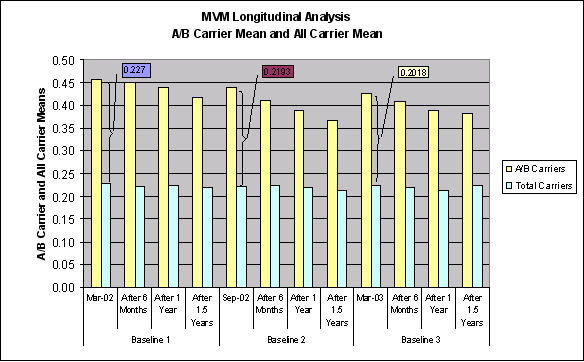 D
D
Figure A-8: Longitudinal Analysis of AIM- A/B Carrier Mean and All Carrier Mean
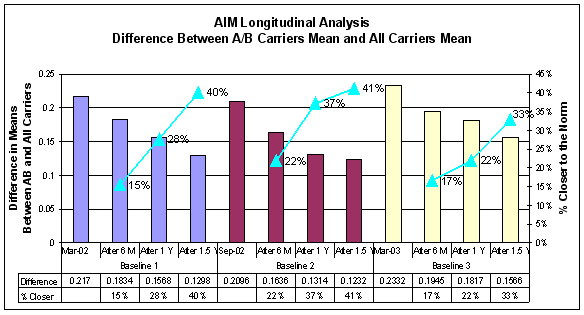 D
D
Figure A-9: Longitudinal Analysis of AIM- Difference Between A/B Carrier Mean and All Carrier Mean
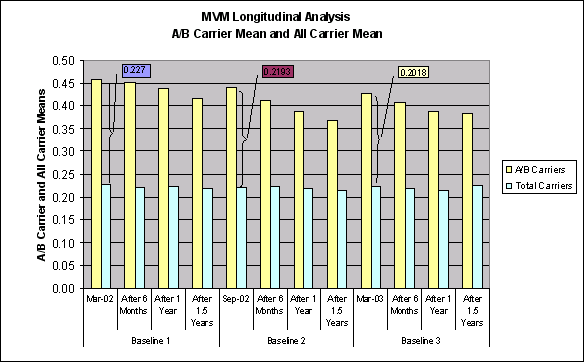 D
D
Figure A-10: Longitudinal Analysis of MVM- A/B Carrier Mean and All Carrier Mean
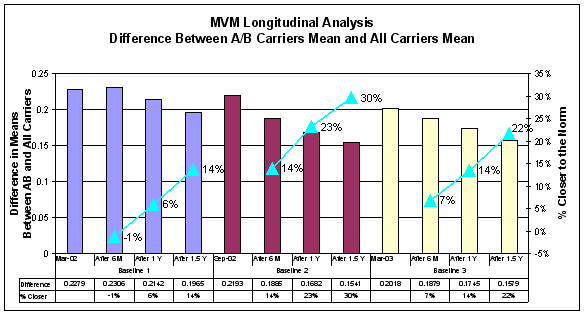 D
D
Figure A-11: Longitudinal Analysis of MVM- Difference Between A/B Carrier Mean and All Carrier Mean
 D
D
Figure A-12: Longitudinal Analysis of DIM- A/B Carrier Mean and All Carrier Mean
 D
D
Figure A-13: Longitudinal Analysis of DIM- Difference Between A/B Carrier Mean and All Carrier Mean
 D
D
Figure A-14: Longitudinal Analysis of VIM- A/B Carrier Mean and All Carrier Mean
 D
D
Figure A-15: Longitudinal Analysis of VIM- Difference Between A/B Carrier Mean and All Carrier Mean
 D
D
Figure A-16: Longitudinal Analysis of SMRM- A/B Carrier Mean and All Carrier Mean
 D
D
Figure A-17: Longitudinal Analysis of SMRM- Difference Between A/B Carrier Mean and All Carrier Mean
 D
D
Figure A-18: Longitudinal Analysis of DOOS- A/B Carrier Mean and All Carrier Mean
 D
D
Figure A-19: Longitudinal Analysis of DOOS- Difference Between A/B Carrier Mean and All Carrier Mean
 D
D
Figure A-20: Longitudinal Analysis of VOOS- A/B Carrier Mean and All Carrier Mean
 D
D
Figure A-21: Longitudinal Analysis of VOOS- Difference Between A/B Carrier Mean and All Carrier Mean
| Baseline | Base Value | After 6 months | After 1 year | After 1.5 years |
|---|---|---|---|---|
| SRCR | ||||
| ISS Carriers | ||||
| 1 | 0.0396 | 0.0357 | 0.0335 | 0.0344 |
| 2 | 0.0410 | 0.0381 | 0.0370 | 0.0370 |
| 3 | 0.0382 | 0.0370 | 0.0370 | 0.0350 |
| All Carriers | ||||
| 1 | 0.0186 | 0.0185 | 0.0192 | 0.0202 |
| 2 | 0.0185 | 0.0192 | 0.0202 | 0.0211 |
| 3 | 0.0192 | 0.0202 | 0.0211 | 0.0206 |
| Difference (ISS Carriers - All Carriers) | ||||
| 1 | 0.0210 | 0.0172 | 0.0143 | 0.0142 |
| 2 | 0.0225 | 0.0190 | 0.0168 | 0.0159 |
| 3 | 0.0190 | 0.0168 | 0.0159 | 0.0144 |
| DOOS | ||||
| ISS Carriers | ||||
| 1 | 0.1161 | 0.1102 | 0.1029 | 0.0954 |
| 2 | 0.1131 | 0.1088 | 0.1028 | 0.0952 |
| 3 | 0.1088 | 0.1028 | 0.0952 | 0.0884 |
| All Carriers | ||||
| 1 | 0.0784 | 0.0758 | 0.0729 | 0.0706 |
| 2 | 0.0758 | 0.0729 | 0.0706 | 0.0676 |
| 3 | 0.0729 | 0.0706 | 0.0676 | 0.0660 |
| Difference (ISS Carriers - All Carriers) | ||||
| 1 | 0.0377 | 0.0344 | 0.0300 | 0.0248 |
| 2 | 0.0373 | 0.0359 | 0.0322 | 0.0276 |
| 3 | 0.0359 | 0.0322 | 0.0276 | 0.0224 |
| VOOS | ||||
| ISS Carriers | ||||
| 1 | 0.2805 | 0.2765 | 0.2703 | 0.2655 |
| 2 | 0.2791 | 0.2783 | 0.2771 | 0.2679 |
| 3 | 0.2783 | 0.2772 | 0.2679 | 0.2687 |
| All Carriers | ||||
| 1 | 0.2105 | 0.2102 | 0.2081 | 0.2101 |
| 2 | 0.2102 | 0.2081 | 0.2101 | 0.2073 |
| 3 | 0.2081 | 0.2101 | 0.2073 | 0.2137 |
| Difference (ISS Carriers - All Carriers) | ||||
| 1 | 0.0700 | 0.0663 | 0.0622 | 0.0554 |
| 2 | 0.0689 | 0.0702 | 0.0670 | 0.0606 |
| 3 | 0.0702 | 0.0671 | 0.0606 | 0.0550 |