
2006
Large Truck
Crash Overview
Analysis Division
Federal Motor Carrier Safety Administration
U.S. Department of Transportation

Publication No. FMCSA-RI-07-033
December 2007
The mission of the Federal Motor Carrier Safety Administration (FMCSA)
is to promote the safe operation of commercial vehicles on our Nation’s
highways. Of the 42,642 people killed in motor vehicle crashes in 2006,
12% (4,995) died in crashes that involved a large truck. Another 106,000
people were injured in crashes involving large trucks. Only about 16% of
those killed and 22% of those injured in large truck crashes were occupants
of large trucks.
Trends
-
Fatal Crashes.
From 1996 to 2006, the number of large trucks involved in
fatal crashes dropped from 4,775 to 4,732—down by 0.5%. The number of large
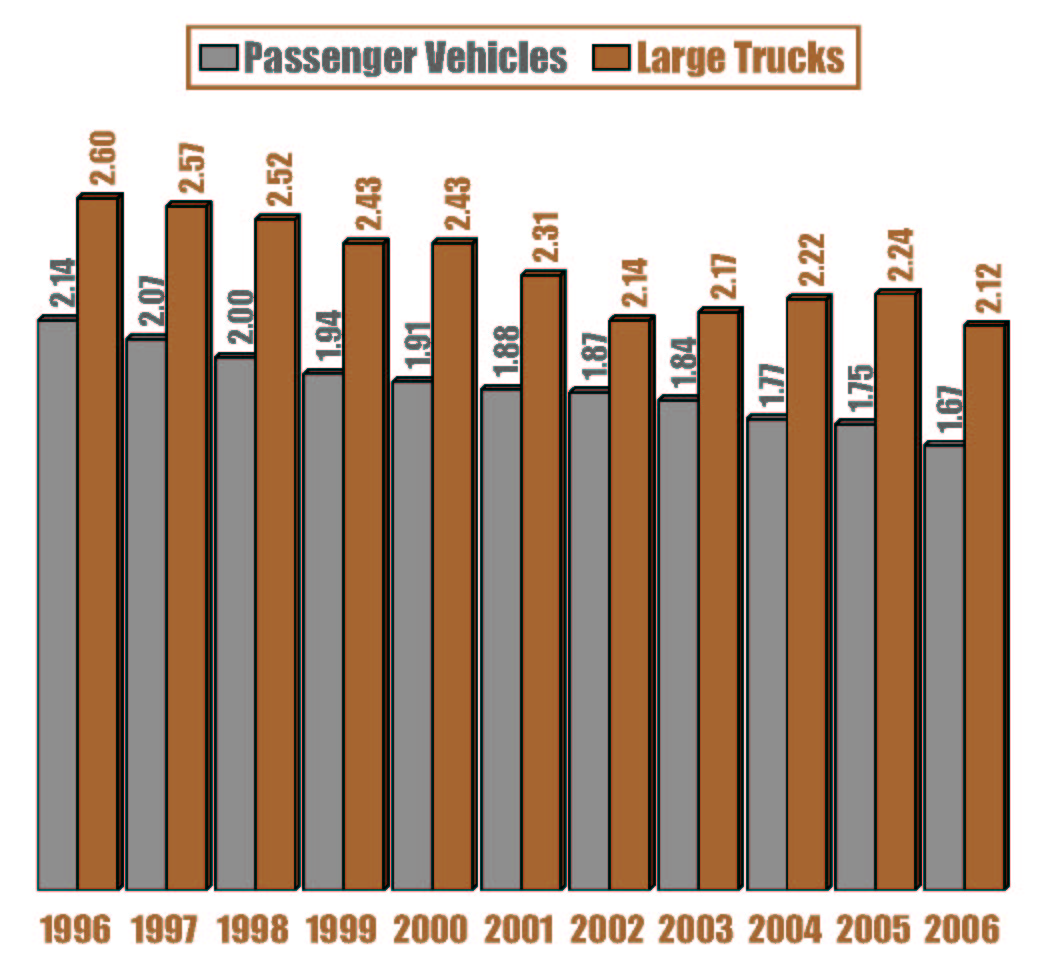
trucks in fatal crashes per 100 million vehicle miles traveled declined
in these years from 2.60 to 2.12— down 18%. The same rate for passenger
vehicles fell from 2.14 to 1.67—down 22% (Figure 1).
Figure 1. Vehicles Involved in Fatal Crashes per 100 Million Vehicle Miles Traveled
-
Injury Crashes.
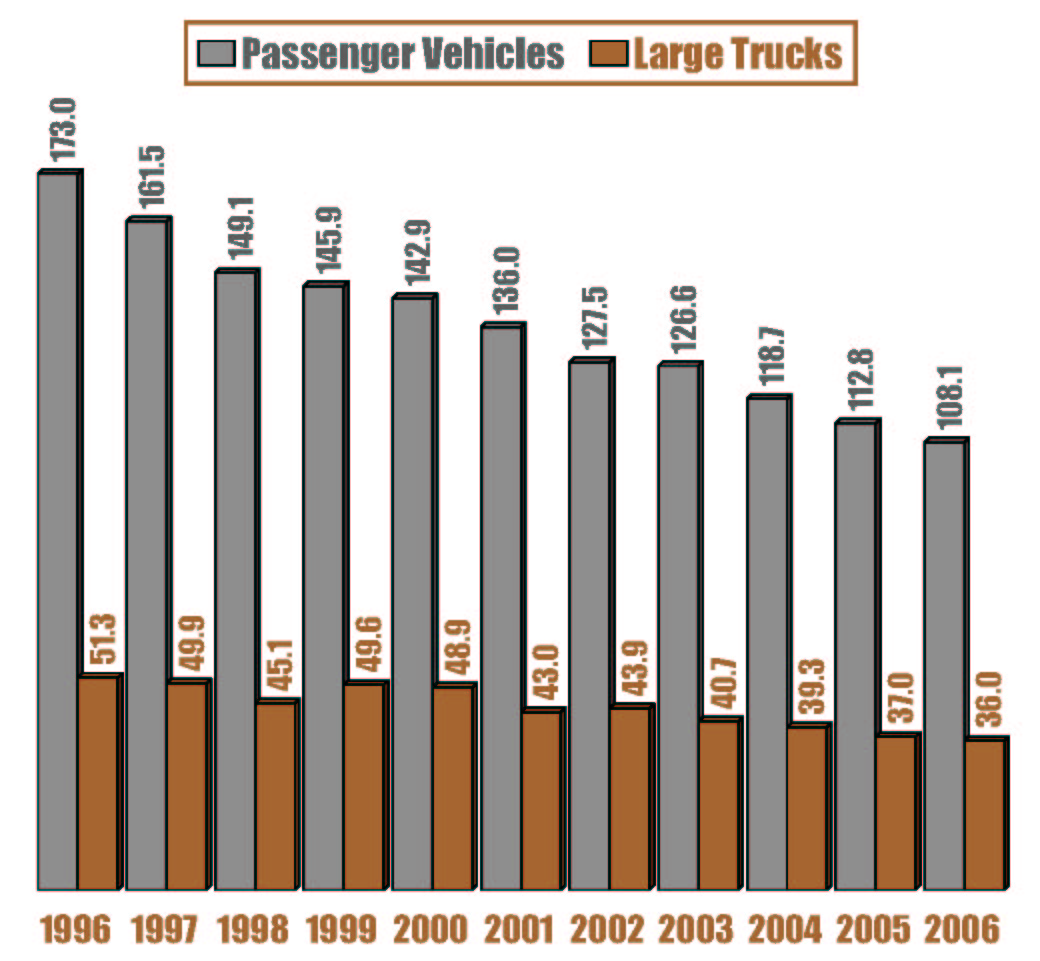
From 1996 to 2006, the number of large trucks involved
in injury crashes per 100 million vehicle miles traveled declined by 30%,
while the rate for passenger vehicles dropped by 38% (Figure 2).
Figure 2. Vehicles Involved in Injury Crashes per 100 Million Vehicle Miles Traveled
Vehicles
-
In 2006, large trucks accounted for 7% of all vehicle miles traveled and
3% of all registered vehicles in the United States. In motor vehicle crashes,
large trucks represented:
8% of vehicles in fatal crashes
3% of vehicles in injury crashes
4% of vehicles in property-damage-only crashes.
-
Large truck tractors pulling semi-trailers accounted for 63% of the large
trucks involved in fatal crashes and 47% of the large trucks involved in
nonfatal crashes.
-
Doubles (truck tractors pulling a semi-trailer and a full trailer) were
only 3% of large trucks involved in fatal and nonfatal crashes. Triples
(truck tractors pulling three trailers) accounted for 0.1% of all large
trucks involved in fatal crashes.
-
Only 4% of large trucks involved in fatal crashes and 2% of large trucks
involved in nonfatal crashes were carrying hazardous materials (HM). HM
was released from the cargo compartment in 12% of these crashes.
Drivers
-
Only 2% of the drivers of large trucks involved in fatal crashes in 2006
were legally intoxicated (blood alcohol content of 0.08 grams per deciliter
or higher), as compared with 23% of passenger car drivers and 24% of light truck
drivers in fatal crashes. Only 3% of the drivers of large trucks involved
in fatal crashes had any alcohol in their bloodstream.
-
Seventy-eight percent of the drivers of large trucks involved in fatal
crashes were reported by police as wearing their safety belts, compared
with 61% of passenger vehicle drivers involved in fatal crashes.
-
In fatal crashes involving large trucks, driver- related factors were cited
for 39% of the large truck drivers. In comparison, driver-related factors
were noted for 66% of passenger vehicle drivers involved in fatal crashes.
Some of the most common factors cited for drivers of large trucks and drivers
of passenger vehicles were the same: driving too fast, failure to keep in
proper lane, inattention, and failure to yield the right of way.
Crash Environment
-
Speeding (exceeding the speed limit or driving too fast for conditions)
was a factor in 23% of the fatal crashes involving a large truck, compared
with 33% of all fatal crashes.
-
No adverse weather conditions were reported for 87% of the fatal crashes
and for 89% of the nonfatal crashes involving large trucks. Rain was the
most common adverse weather condition.
-
In 76% of the fatal crashes and 70% of the nonfatal crashes involving large
trucks, the first harmful event was a collision with another vehicle in
transport.
-
In two-vehicle fatal rear-end crashes, passenger vehicles struck large
trucks in the rear approximately three times more often than large trucks
struck passenger vehicles in the rear—17% versus 6% (Figure 3).
Figure 3. Large Trucks Involved in Fatal Crashes with Passenger Vehicles by Crash Type

-
In all other two-vehicle fatal crashes involving a large truck and a passenger
vehicle, the passenger vehicle struck the large truck more often than the
reverse—37% versus 35%.
-
Rollover was the first harmful event for only 5% of the fatal crashes and
only 2% of the nonfatal crashes involving large trucks.
-
Twenty-four percent of fatal crashes that took place in work zones—areas
of construction, maintenance, or utility activity—involved a large truck.
Definitions
Large Trucks: Trucks over 10,000 pounds gross vehicle weight rating (GVWR).
Passenger Vehicles: Passenger cars and light trucks—such as vans, sport
utility vehicles, and pickup trucks—with 10,000 pounds GVWR or less.
Data Sources
Fatal Crash Data: National Highway Traffic Safety Administration, Fatality
Analysis Reporting System (FARS).
Nonfatal Crash Data: National Highway Traffic Safety Administration, General
Estimates System (GES); and FMCSA, Motor Carrier Management Information
System (MCMIS) crash file.
Vehicle Miles Traveled: Federal Highway Administration.
For more information, contact the Analysis Division at (202) 366-0324,
or visit our web sites at www.fmcsa.dot.gov and ai.fmcsa.dot.gov.
MC-RAA/12(5M)EV